
CareerArc alternative (2026): CareerArc vs RecruitmentAds
CareerArc (now HireSocial) is a social-recruiting publisher: it syncs your ATS, writes the captions, auto-brands a static image per job, and posts the result across your company, recruiter and employee profiles. RecruitmentAds.com does the other half: one vacancy URL in, a finished set of video and static ads for that role out, inside your locked template, with AI visuals, real employee photos or approved assets only as the visual source. If you want to know which you are actually buying, evaluate both on one live vacancy: CareerArc offers a 30-day free trial, no credit card, and RecruitmentAds will build the finished set from your job link, with the plan and 90-day pilot that cover it published on our pricing page.
Vendor facts verified 5 August 2026 against CareerArc's own pages. Pricing and review data re-checked every 90 days.
What each tool is
CareerArc
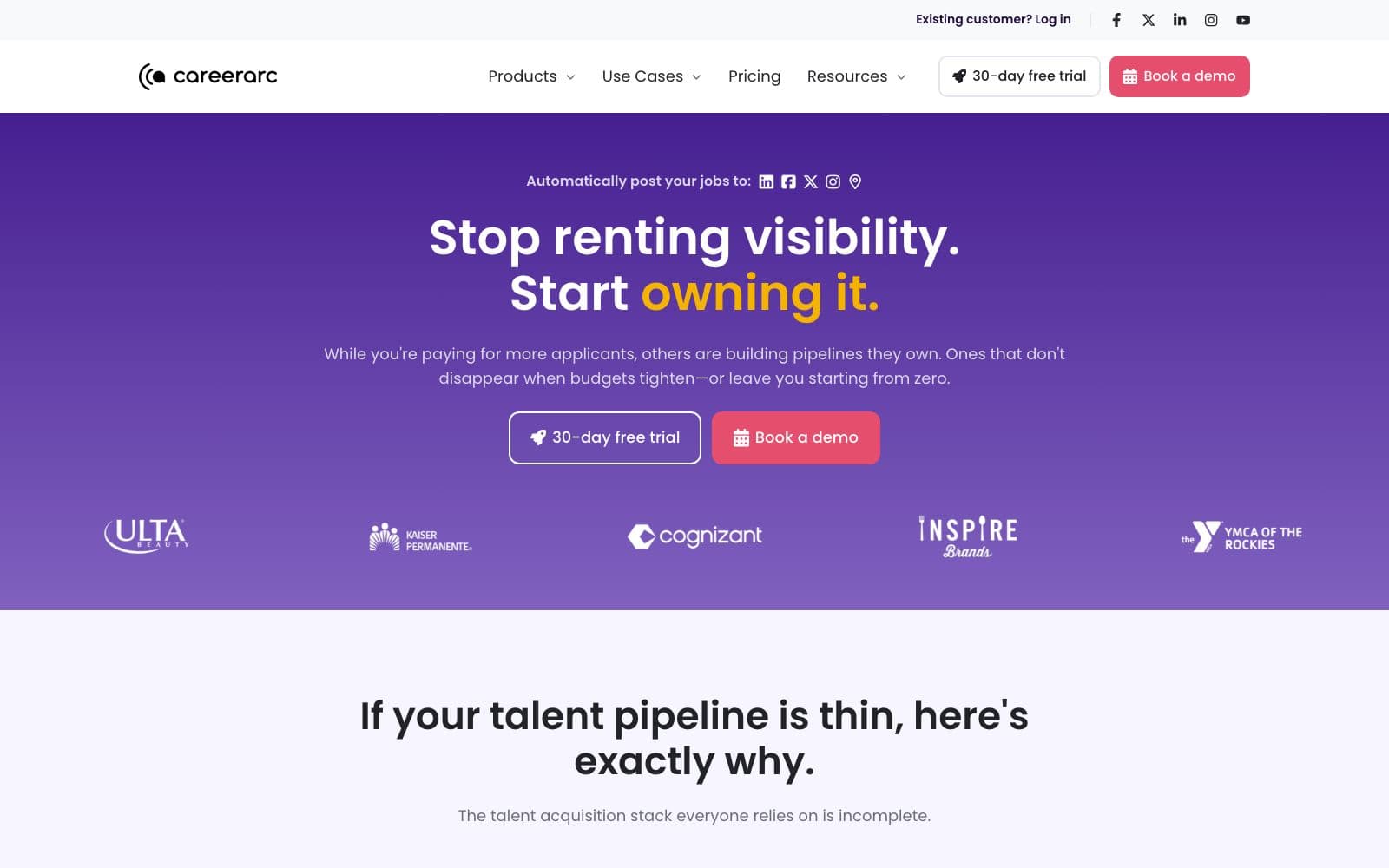
CareerArc is a US social-recruiting platform, founded in 2009 as TweetMyJobs and relaunched as HireSocial in February 2025. It syncs jobs from your ATS or career site (80+ ATS integrations claimed, around 15 named), then auto-writes post captions, auto-brands static images, and publishes them organically to company, career, recruiter and employee-ambassador profiles on LinkedIn, Facebook, X and Instagram. The distribution side is the product: unlimited profiles, set-and-forget scheduling, admin post approval with each profile owner choosing their own publishing frequency, and, by CareerArc's own count, over 200 million posts published for customers.
RecruitmentAds.com
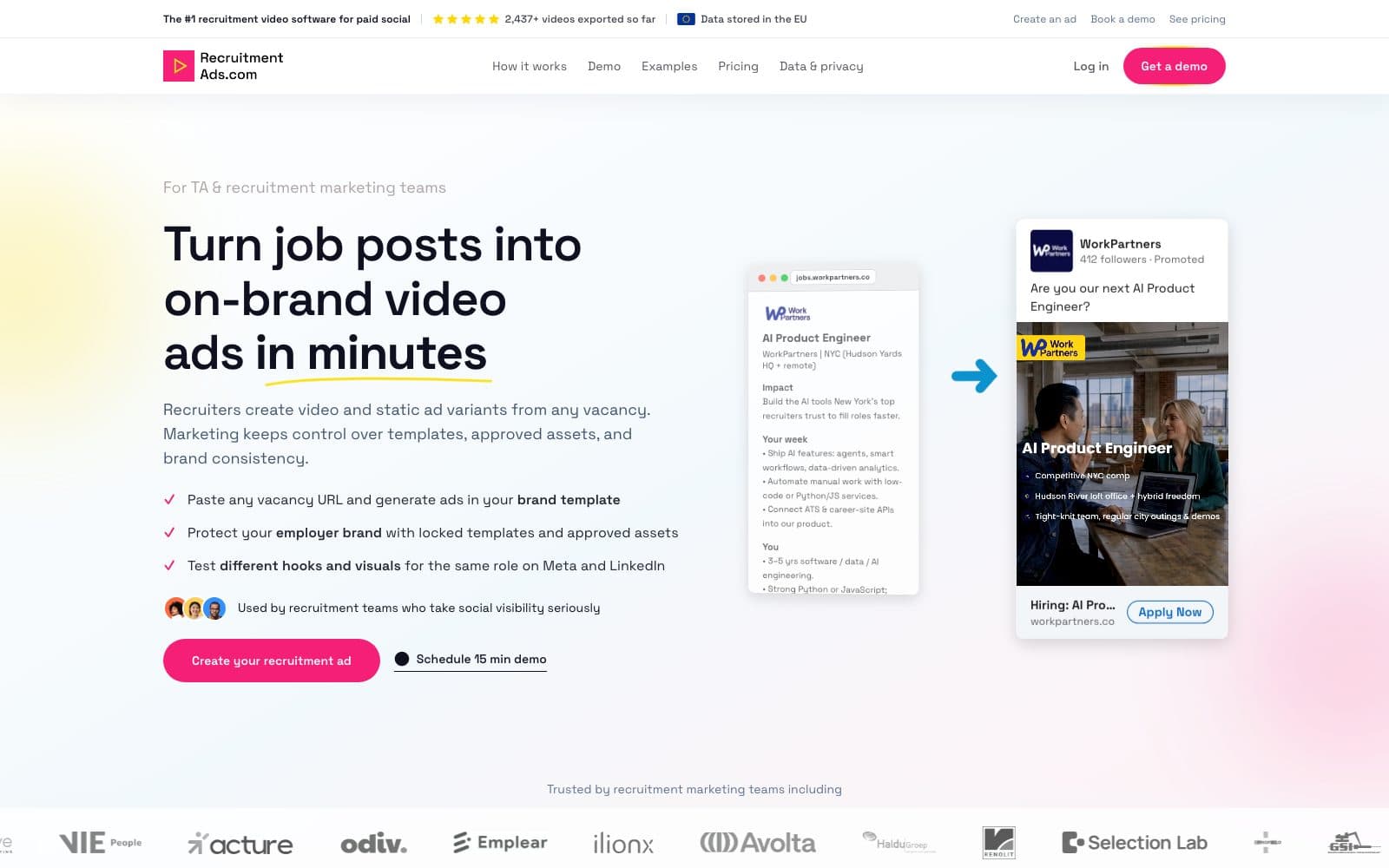
RecruitmentAds.com is a recruitment-ad creative tool. You paste a vacancy URL or the job text and get a finished set for that role: video in 9:16, 4:5, 1:1 and landscape, plus matching static variants, built inside a locked brand template with AI voice-over and on-screen text in any language. Marketing chooses the visual source per template: AI scenes generated from the job description, real employee photos in on-brand layouts, or approved assets only with no synthetic people. It does not publish or schedule: you export the files and upload them wherever you post or run paid campaigns.
When each tool wins
Evaluate both on one live vacancy. Run CareerArc's 30-day free trial against your posting cadence, and ask RecruitmentAds for the finished video and static set built from the same job link; the plan and the 90-day pilot that cover that output are published on our pricing page, so nothing about the output or the price waits on a quote.
When CareerArc wins
Hundreds of jobs flowing out of your ATS onto dozens of company, recruiter and employee profiles on a schedule, with nobody uploading anything by hand, is CareerArc's core machine. RecruitmentAds has no equivalent: it hands you files, it does not publish or schedule posts.
Recruiter and employee-ambassador profiles, per-profile publishing frequency, admin post approval and leaderboards are a distribution programme CareerArc has run since 2009. None of that exists in RecruitmentAds.
At several hundred live roles where every vacancy needs a post rather than a piece of creative, CareerArc's autodetected logo and brand colours on an autogenerated image is the pragmatic answer, and video per role is not something you are being asked for.
When RecruitmentAds wins
Paste the job link and get the 9:16, 4:5, 1:1 and landscape cuts plus matching statics in your locked template. CareerArc's video comes only through Lumina, which it acquired in April 2024, still sells separately, and lists in none of its published HireSocial tiers, with delivery quoted at hours to 24 hours rather than on the spot.
AI scenes built from the job description, real employee photos placed in on-brand layouts, or approved assets only with no synthetic people. All three are locked per template, so recruiters cannot go outside it. CareerArc's brand layer autodetects your logo and colours and applies them to autogenerated images; there is no employee-photo or approved-assets-only mode.
One export covers Meta and LinkedIn paid placements, organic posts, career pages and recruiter outreach, in any language you need it in. RecruitmentAds sells the creative, not the channel: it does not buy media and does not post for you.
Who should pick what
Sole recruiter or small in-house team
CareerArc's Starter tier ($167/mo billed annually for up to 10 jobs, one user and one profile) is the cheap way to keep jobs flowing onto social, while RecruitmentAds is the buy when what is missing is the ad itself: a finished video and static set per vacancy at the credit prices published on its pricing page.
TA team inside an enterprise or high-volume employer
CareerArc is the incumbent fit for organic distribution at scale (unlimited profiles, ATS/XML autosync on Growth, an employee-advocacy programme), and it wins outright if native ATS integration is the requirement, because RecruitmentAds has none; RecruitmentAds wins when the requirement is finished paid-social creative per vacancy in a locked template.
Employer-branding-led buyer
RecruitmentAds is usually the answer when brand or legal has a position on synthetic people, because the visual source is locked per template (AI scenes, real employee photos, or approved assets only), where CareerArc autodetects your logo and colours and applies them to autogenerated images with no equivalent mode choice.
Ready to evaluate CareerArc vs RecruitmentAds on your own vacancy? Try it in a 90-day pilot, or request a sample with your job link.
Row by row
Facts verified 2026-08-05. “—” means not published by the vendor.
| Comparison | CareerArc | RecruitmentAds |
|---|---|---|
| What it is | CareerArc (HireSocial) syncs your ATS and auto-generates branded captions and static images, publishing them organically across company, recruiter and employee social profiles. | RecruitmentAds turns a single vacancy URL into a finished set of video and static ads for that role, inside a locked brand template. |
| Category overlap | CareerArc is a direct competitor in social recruiting creative and publishing. | RecruitmentAds overlaps CareerArc on creative generation and brand control, not on publishing: RecruitmentAds does not post, schedule or distribute. |
| How a vacancy gets in | CareerArc ingests vacancies via ATS and career-site sync (80+ ATS claimed) with XML feed autosync. | RecruitmentAds takes a vacancy URL or pasted job text (any careers-site or job-board link works) and does not integrate natively with ATS platforms. |
| Video output | CareerArc offers video only via Lumina, a separately-sold product it acquired in April 2024, with asynchronous hours-to-24h turnaround. | RecruitmentAds exports video for the vacancy in 9:16, 4:5, 1:1 and landscape with AI voice-over, from the same job link, in the plan you are already on. |
| Static output | CareerArc auto-generates branded static images for social posts, with logo and brand colors autodetected. | RecruitmentAds exports static variants alongside the video from the same vacancy, so video-versus-image tests use the same template and copy. |
| Paid ad sets for Meta and LinkedIn | CareerArc produces organic social posts only: no paid Meta/LinkedIn ad-set output was observed anywhere as of 5 August 2026. | RecruitmentAds exports the video and static formats Meta and LinkedIn campaigns take, and buys no media itself; you upload the set to your own ad accounts. |
| Distribution and scheduling | CareerArc publishes for you: unlimited company, career, recruiter and employee profiles on LinkedIn, Facebook, X and Instagram, with scheduling, admin post approval, and publishing frequency set by each profile owner. | RecruitmentAds stops at the export: there is no publishing, scheduling or employee-advocacy layer, so it sits behind whatever you already post with. |
| Visual-source choice | CareerArc gives you autogenerated imagery with your logo and colours applied, or your own uploaded marketing images. No real-employee-photo mode and no approved-assets-only mode were observed. | RecruitmentAds offers three visual sources per template: AI scenes from the job description, real employee photos in on-brand layouts, or approved assets only with no synthetic people. |
| Brand control | CareerArc offers brand approximation rather than governance: autodetected logo and colors applied to autogenerated images, with no locked templates or approved-asset library. | RecruitmentAds locks the template, fonts, colours and permitted visual modes so recruiters export inside marketing's rules; it does not ship role-based approval chains. |
| ATS integrations | CareerArc claims 80+ ATS integrations but names only around 15 on its features page, including Workday, Greenhouse and iCIMS. | RecruitmentAds has no native ATS integration; the job link is the interface, which is why it works on any vacancy page without an IT project. |
| Languages | CareerArc publishes no localization information; language support was unknown as of 5 August 2026. | RecruitmentAds generates on-screen text and AI voice-over in any language, from the same vacancy, on the same template. |
| Pricing and what you can check before buying | CareerArc publishes self-serve pricing from $167/mo (Starter, annual) up to $959/mo (Growth, monthly) with a 30-day free trial. | RecruitmentAds publishes employer and agency plan tiers and 90-day pilot fees on its pricing page in EUR, GBP and USD, where one credit is one finished creative set. |
| Best for | CareerArc is best for US enterprise and high-volume employers running organic social recruiting at scale. | RecruitmentAds is best for teams that need a finished video and static ad set per vacancy, on a locked template, with marketing choosing the visual source. |
| Core market | CareerArc's core market is the United States; no localization or non-US market pages were found. | RecruitmentAds prices in EUR, GBP and USD by region and stores customer data in the EU, with a standard DPA pack published for procurement review. |
Every alternatives listicle on this SERP still describes CareerArc as a posting tool with no video. It bought one. CareerArc announced its acquisition of Lumina, a platform that generates visual job postings from existing job descriptions, on 3 April 2024. More than two years later, as of 5 August 2026, three things are still true: video appears in none of the three published HireSocial tiers, so its price is not knowable from CareerArc's pricing page; lumina.co is still a standalone site that does not mention CareerArc ownership and gates access behind an invitation request; and the delivery promise is asynchronous on both sites: "within a matter of hours" on careerarc.com, 24 hours on lumina.co. None of that makes CareerArc a worse posting platform. It does mean that if video is why you are shopping, the CareerArc answer is a second purchase whose packaging you have to ask about, and the honest comparison is between that and a per-vacancy export you can price and test yourself.
Switching
What changes
- The unit of work. CareerArc's unit is a post per job, generated and published continuously from the feed. RecruitmentAds' unit is a finished creative set for a vacancy you chose: one credit, one set, video plus statics.
- Who presses publish. CareerArc posts to your profiles on a schedule. RecruitmentAds gives you files; you or your scheduler upload them, and paid campaigns run from your own Meta and LinkedIn ad accounts.
- Where brand is enforced. CareerArc autodetects your logo and colours and applies them to autogenerated images. RecruitmentAds enforces a locked template and a permitted visual source, set up once by marketing.
What maps to what
- ATS or XML feed → a vacancy URL. Anything with a live job page maps straight across; you paste the link instead of wiring a feed.
- Autogenerated captions → the script, on-screen text and AI voice-over generated from the same job description, editable before export.
- Auto-branded static image → the static variants that come out of your template with the video, in the sizes Meta and LinkedIn take.
- Uploaded marketing images → the approved-assets-only or employee-photo visual source, with those assets loaded into the template once rather than attached per post.
- Post approval before publishing → approval before export, inside the locked template. This is not a like-for-like swap: RecruitmentAds does not ship multi-step or role-based approval workflows today, so if your sign-off chain is the reason CareerArc works for you, test that first.
What you keep
- Your ATS, untouched. RecruitmentAds does not connect to it, so nothing about your requisition flow changes.
- Your social profiles, scheduler and employee-advocacy programme, including CareerArc itself, if the posting machine is what you value. The exported set is a file; it can go into whatever publishes today.
- Your Meta and LinkedIn ad accounts, pixels and audiences.
- Your brand assets and employee photography, under your existing consent process for employee media.
Evaluate RecruitmentAds on your own vacancy
The fastest way to settle a CareerArc comparison is to stop reading feature tables and look at one real role. Send a live vacancy URL and we build the set for it: video in 9:16, 4:5, 1:1 and landscape plus matching statics, in your template, with the visual source you are allowed to use. Plans, credits and 90-day pilot fees are published on the pricing page in EUR, GBP and USD, so you can see what that output costs before anyone talks to you. If CareerArc's posting machine is what you need, its 30-day free trial will tell you that just as quickly. Run both on the same job.
Questions buyers actually ask
Does CareerArc make recruitment videos?
Not inside HireSocial. CareerArc's video comes through Lumina, which it acquired in April 2024 and still sells as a separate product on lumina.co. Video appears in none of the three published HireSocial tiers, and turnaround is quoted as hours to 24 hours. RecruitmentAds generates the video for a vacancy from its URL, in the plan you are on.
What does CareerArc cost, and how does that compare to RecruitmentAds?
CareerArc publishes Starter at $167/mo billed annually and Growth at $959/mo monthly, with Enterprise custom (5 August 2026). RecruitmentAds publishes its employer and agency tiers and 90-day pilot fees on its pricing page in EUR, GBP and USD. The tiers are not like-for-like: CareerArc prices jobs posted and profiles, RecruitmentAds prices finished creative sets, one credit per set.
Can we use CareerArc and RecruitmentAds together?
Yes, and for some teams that is the honest answer. CareerArc keeps syncing your ATS and posting to company, recruiter and employee profiles; RecruitmentAds produces the per-vacancy video and static set that goes into your paid campaigns or your best roles. There is no integration between the two products: you export files from one and upload them where you publish.
Will our employer brand actually be respected?
Both tools brand the output, differently. CareerArc autodetects your logo and brand colours, applies them to autogenerated images, and has an admin approve posts before they publish. RecruitmentAds puts the control earlier: every export runs through a locked template fixing fonts, colours and the permitted visual source, whether that is AI scenes, real employee photos, or approved assets only. RecruitmentAds does not ship multi-step approval chains, so the template is the guardrail rather than a sign-off queue.
How do we evaluate both without a long sales process?
Take one live vacancy and put it through both. CareerArc's 30-day free trial shows you the posting cadence on your own jobs. RecruitmentAds builds the finished video and static set from that same job link, and the plan plus 90-day pilot covering it is published on the pricing page, so the only thing you cannot check upfront is what Lumina video would cost on top, because it is in no published tier.