
Papirfly alternative (2026): Papirfly vs RecruitmentAds
This page compares the two tools on recruitment ad creative. If you are shopping Papirfly against Bynder, Frontify, Canto or Cloudinary for digital asset management, RecruitmentAds does not belong on that shortlist: we do not sell a DAM.
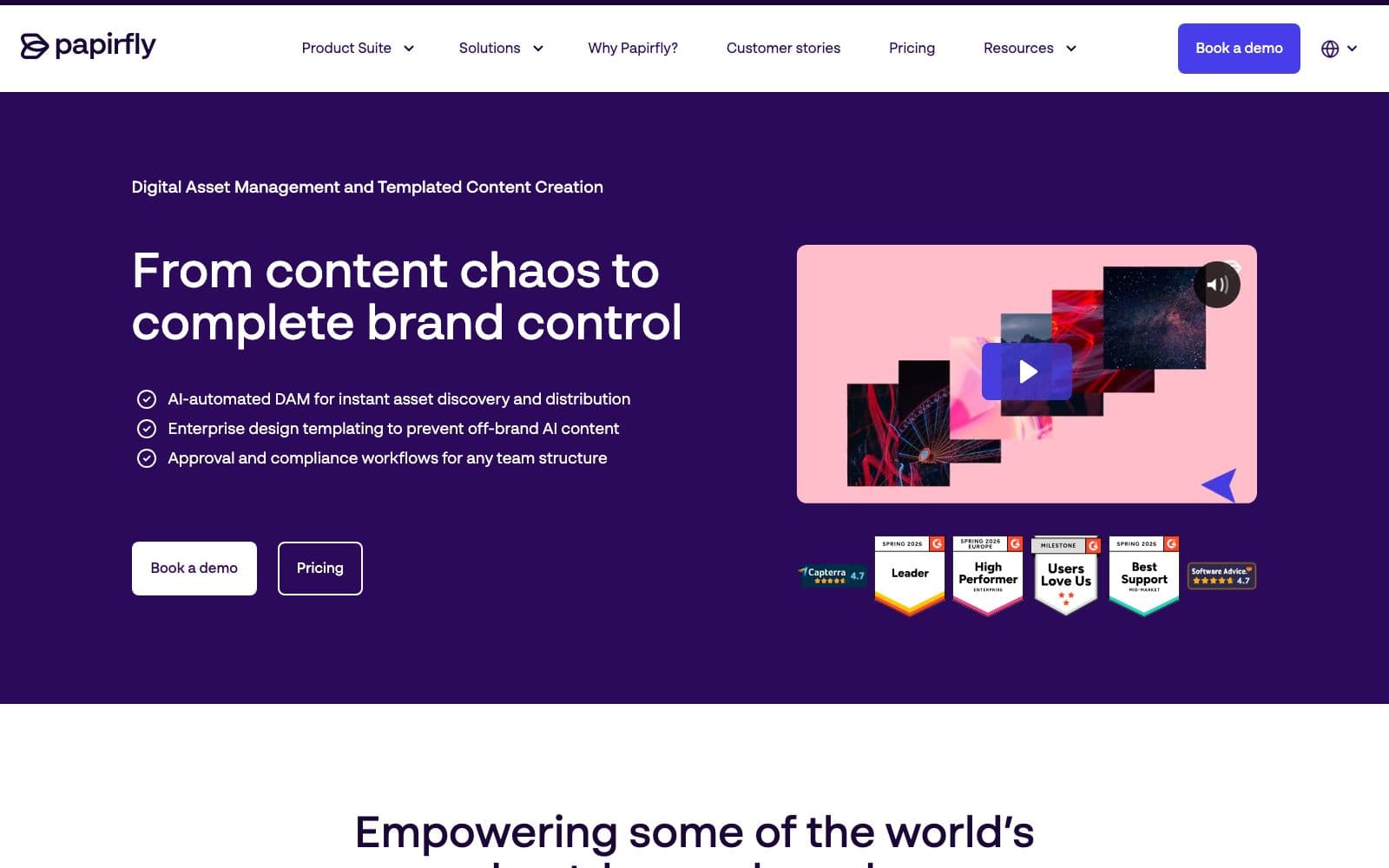
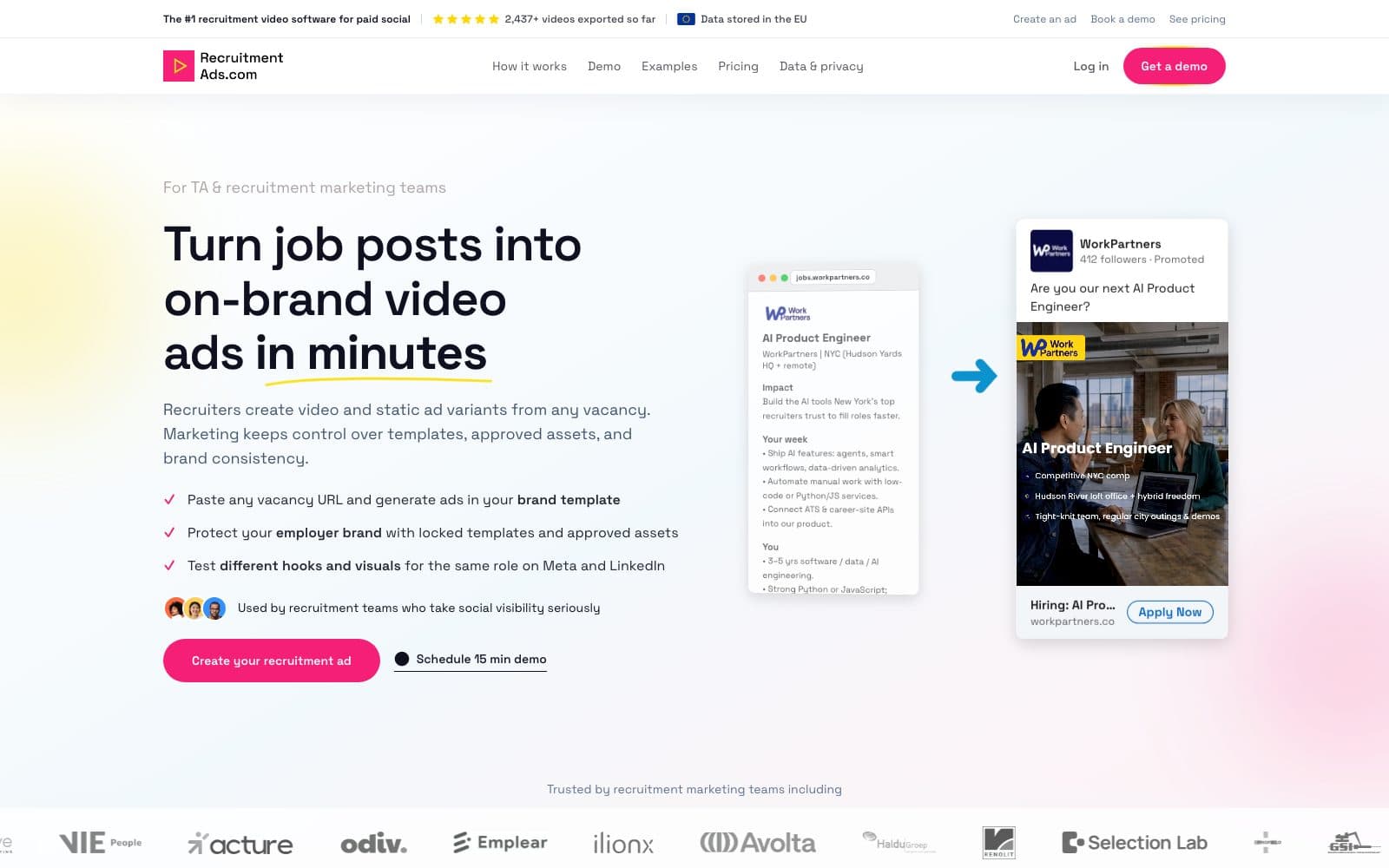
Papirfly is an enterprise brand-governance suite (brand portal, digital asset management and locked-template content creation) with a dedicated employer-branding and talent-acquisition solution: HR teams produce on-brand job ads, social posts and branded video inside templates marketing has already signed off. RecruitmentAds does one narrower job: it turns a single vacancy URL into a finished ad-set for that role (a recruitment video in every standard format plus matching statics) which you upload to your own Meta and LinkedIn campaigns, with the visual source your choice per template: AI visuals from the job description, real employee photos, or approved assets only. RecruitmentAds is also the easier of the two to evaluate upfront: plan tiers, credit volumes and 90-day pilot terms are published on our pricing page, and you can see the output on your own job link before a sales call.
Papirfly facts checked against papirfly.com on 5 August 2026. Review, headcount and revenue figures are secondhand and labelled below.
What each tool is
Papirfly
Papirfly is a Norwegian brand-governance platform, founded in Oslo in 2000 and majority-owned by Verdane since February 2022. It combines digital asset management, a brand portal and templated content creation, and claims more than 1 million regular users across 1,500-plus brands including BMW, Mercedes-Benz, Mondelēz, PepsiCo and SAP. Its employer-branding and talent-acquisition solution lets HR teams produce studio-quality recruitment materials (job ads, social posts, event signage, digital brochures, print-ready PDFs and branded video) inside templates where marketing has locked the elements that must never change, with brand guardians signing off before anything ships. Localisation is a flagship capability: content adapts to regional languages with the lock-in protections intact, and Papirfly's AI auto-generates and translates video subtitles.
RecruitmentAds
RecruitmentAds is an AI recruitment-creative tool. Paste a vacancy URL and it returns a finished on-brand ad-set for that role (a recruitment video in 9:16, 4:5, 1:1 and landscape plus matching static versions) built inside a locked brand template, with AI voice-over and versions in any language. Marketing decides per template whether recruiters may use AI visuals generated from the job description, real employee photos placed in on-brand layouts, or approved assets only with no AI people. It is not an asset-management system and it produces nothing for print: it makes paid-social and organic recruitment creative, which you or your agency upload to your own Meta and LinkedIn campaigns. Plans, credit volumes and 90-day pilot terms are published.
When Papirfly wins, and when RecruitmentAds wins
Both tools put recruitment creative inside a template marketing controls. Only one of them lets you price the evaluation and see the output on your own vacancy before a sales conversation: RecruitmentAds publishes plan tiers, credit volumes and 90-day pilot terms, while Papirfly is quoted per chosen module and, in its own words, agreements "typically begin with a 12-month contract".
When Papirfly wins
Your brand team is buying one governed home for every asset, and HR is a tenant in it
Papirfly's centre of gravity is the whole company's brand: a DAM with auto-tagging and natural-language search, a brand portal, print and signage output, franchise and agency access. Recruitment materials are one shelf in that building. RecruitmentAds has no DAM, no brand portal and no print path, and would be a strange answer to an enterprise brand-operations brief. If the procurement question is "where does all our brand content live", Papirfly is in the room and we are not.
Your policy forbids AI-written copy and AI-made imagery outright
Papirfly states its position plainly: "We don't use generative AI to create imagery or copy that could misrepresent the brand" (papirfly.com/ai/, 5 August 2026); its AI does tagging, search, quality checks and subtitle translation instead. RecruitmentAds can match the imagery half of that, because approved-assets-only is one of our three visual modes, but AI writes the script and the voice-over in every mode. If AI-generated copy is itself the blocker, Papirfly's stated design matches your policy and ours does not.
You need one system producing 14 markets of print, signage and brochures, not feed ads
Event signage, interactive digital brochures, print-ready PDFs, regional asset tagging and localisation with lock-in intact are Papirfly's ground, proven at BMW and PepsiCo scale. RecruitmentAds exports video and static files sized for Meta and LinkedIn placements and nothing else. A team whose recruitment output is mostly physical and multi-format is buying the wrong tool in us.
When RecruitmentAds wins
You want the vacancy itself to be the input
RecruitmentAds starts from a live job link: it pulls the title, requirements, perks, logo, fonts and brand colours into your locked template and returns the finished set. No vacancy or job-URL input appears anywhere on Papirfly's published product pages (checked 5 August 2026); a recruiter opens a template and fills it in, which is a design workflow rather than a per-vacancy one.
You want the channel output finished, not the asset
One credit is one finished creative set: an approved video concept for that role in 9:16, 4:5, 1:1 and landscape, matching statics for a video-versus-image test, and edits before export. Papirfly hands you on-brand materials and stops there: it owns no paid-social distribution and packages nothing as an ad-set, so a recruiter still assembles the campaign somewhere else.
You want the visual source to be marketing's decision, per template
RecruitmentAds asks which visuals a template may use: AI visuals built from the job description, your real employees' photos placed in on-brand layouts, or approved assets only with no AI people. Papirfly's imagery is approved-assets-only by design (everything comes from the DAM or a pre-approved template option), so the strict mode is the only mode, and the day a regional team has no footage for a hard-to-fill role, there is no second path.
Who should pick what
Sole recruiter
A sole recruiter or a two-person team is not Papirfly's buyer (it is an enterprise suite sold per module to brand and marketing organisations, typically on a 12-month agreement), and RecruitmentAds' published plans with a 90-day pilot are the cheaper way to get a real ad for one live role this week.
TA team
For a TA team of 5–50 the honest split is what you are short of: if you lack brand-safe materials of every kind and your marketing team wants one governed system for all of them, Papirfly; if you have brand rules already and what you lack is a finished, format-complete ad for each vacancy you open, RecruitmentAds.
Employer-branding-led buyer
An employer-branding-led buyer is Papirfly's ideal reader and should take it seriously (governed EVP portal, sign-off workflow, localisation, DAM), and should then ask the one question this comparison turns on: once the material is approved, who turns a specific open role into a campaign that runs, and in which tool.
Ready to evaluate Papirfly vs RecruitmentAds on your own vacancy? Try it in a 90-day pilot, or request a sample with your job link.
Papirfly vs RecruitmentAds, row by row
Every cell is a full sentence naming the tool, so it still means something quoted on its own.
Facts verified 2026-08-05. “—” means not published by the vendor.
| Comparison | Papirfly | RecruitmentAds |
|---|---|---|
| What it is | Papirfly is a PE-backed enterprise brand-governance suite (brand portal, templated content creation, DAM) with a dedicated employer-branding and talent-acquisition solution. | RecruitmentAds is an AI creative tool that turns one vacancy URL into a finished on-brand recruitment ad-set (video in every standard format plus matching statics) for your team to run on Meta and LinkedIn. |
| Category and who buys it | Papirfly is an adjacent employer-branding platform rather than a recruitment-ad product: brand and marketing teams are the primary buyer, and HR is one named solution vertical inside their system. | RecruitmentAds is bought by in-house TA and employer-brand teams and by staffing agencies, for the single job of getting an on-brand ad live for a specific vacancy. |
| How a vacancy gets in | Papirfly has no vacancy ingestion: no job-URL or vacancy input appears anywhere on its published product pages; content starts from approved brand material, guidelines and templates, not from a job. | RecruitmentAds starts from a vacancy URL or pasted job text and pulls the title, requirements, perks, logo, fonts and brand colours into your locked template. |
| Video output | Papirfly's brand video maker gives non-editors a governed template (locked intros, outros, titles, on-screen graphics, transitions and brand colours) inside which they select, trim and position their own clips, and its AI auto-generates and translates subtitles. | RecruitmentAds generates the recruitment video itself from the job link, with AI voice-over, and exports 9:16, 4:5, 1:1 and landscape cuts of the same concept: no footage required, though your own photos can be the visual source. |
| Static ads | Papirfly's core output is locked-template statics, and it goes far wider than feeds: social posts, job advertisements, event signage, digital brochures, banners and print-ready PDFs. | RecruitmentAds includes matching static versions of the same concept in every finished creative set, so a video-versus-image test comes out of one credit. It produces nothing for print. |
| Paid-social ad-sets and distribution | Papirfly ships no paid ad-sets and owns no distribution: a recruiter must take the asset elsewhere and build the campaign, with social publishing available only through third-party integrations such as Hootsuite, Emplifi, TikTok and Social Native. | RecruitmentAds hands over finished ad-sets in the placements Meta and LinkedIn expect, which you or your agency upload to your own ad accounts; it does not buy or manage media, and the programmatic XML-to-Meta flow is an Enterprise-plan option. |
| Visual-source choice | Papirfly's imagery is approved-assets-only by design (visuals come from the DAM or pre-approved template options), and it states that it does not use generative AI to create imagery or copy. | RecruitmentAds makes the visual source a per-template setting: AI visuals built from the job description, real employee photos in on-brand layouts, or approved assets only with no AI people. |
| Brand governance | Papirfly offers full brand governance: locked template fields, flexible elements chosen from pre-approved options, defined free-text areas, role-based access, and sign-off so brand guardians can "check, comment on, and sign off" new employer-brand content. | RecruitmentAds locks the brand template so a recruiter cannot pull random stock or drift the fonts, ships custom on-brand templates on the Custom and Scale plans, and offers user roles and governance controls on the higher plans; it does not claim approval workflows or full role-based access control. |
| Asset management | Papirfly runs a full DAM with auto-tagging, duplication management, natural-language search, facial recognition for GDPR compliance, automatic renditions, version control and an image quality checker. | RecruitmentAds holds the approved assets a template is allowed to use and is not an asset-management system: if a DAM is on your requirements list, it is a reason to keep or buy Papirfly, not to replace it. |
| ATS integration | Papirfly lists no ATS or HR system among its 100-plus integrations, which cover CRM, CMS, e-commerce, design tools, stock libraries and translation instead. | RecruitmentAds has no native ATS or Workday integration today either; vacancies enter by URL or pasted text, so on this row neither tool connects to your hiring system. |
| Languages and markets | Papirfly treats localisation as a flagship capability: teams adapt content for different languages and regional requirements with lock-in protections preserved, video subtitles auto-translate, and dynamic tagging assigns assets by region and team. | RecruitmentAds exports on-screen text and AI voice-over in any language from the same job post and the same locked template, and prices in EUR, GBP or USD by region. |
| Pricing and how you evaluate it | Papirfly publishes no prices: pricing is "based on the solutions you choose" and the scale of the organisation, agreements "typically begin with a 12-month contract", and its FAQ argues that "publishing flat pricing would oversimplify what is often a strategic investment" (5 August 2026). | RecruitmentAds publishes its employer and agency plan tiers, credit volumes and 90-day pilot terms on recruitmentads.com/pricing, so you can price the evaluation before you book a call. |
| Best for | Papirfly is best for large multi-market enterprises whose brand team wants one governed home for the employer brand, with HR producing locked-template materials inside it. | RecruitmentAds is best for teams that already have brand rules and need a finished, format-complete ad-set per vacancy, with media buying and budget staying in their own hands. |
| Core market | Papirfly's core market is the Nordics and Europe (UK, DACH, with a localised German site), plus a North American office in Morristown NJ, and it claims 1,500-plus brands and more than 1 million users. | RecruitmentAds sells to EU, UK and US buyers with regional pricing in EUR, GBP and USD, and localises the same creative into any language rather than staffing regional teams. |
| Vendor scale and validation | Papirfly has roughly 187–207 employees per secondhand sources (Gartner Peer Insights lists 201–500), is majority-owned by Verdane since February 2022, and has rolled up BrandMaster, Meriworks, Keepeek, Brandpad and Adgistics. | RecruitmentAds publishes neither a headcount nor an analyst placement; if a 1,500-brand reference base and enterprise procurement history are requirements, Papirfly meets them and RecruitmentAds does not. |
What most Papirfly comparisons miss
Papirfly's talent-acquisition pages promise to "Make recruitment marketing effortless for everyone", and they deliver that for the production step. What they do not do is either end of a recruitment campaign. Nothing on Papirfly's published product pages describes a vacancy or job-URL input, and there is no ad-set output: no Meta or LinkedIn campaign packaging, no paid-social distribution, and no ATS or HR system among the 100-plus integrations on papirfly.com/integrations/ (read 5 August 2026), where the surface is CRM, CMS, e-commerce, design tools and stock libraries. That is coherent for a brand-governance suite whose buyer is the brand team (the job is making sure every asset is on-brand, not moving a specific requisition into a feed), and it is exactly right for an enterprise that already has campaign execution covered elsewhere. It is worth knowing before you assume the employer-branding platform is also the recruitment-advertising one.
Switching from Papirfly to RecruitmentAds, and when not to
What changes
- The input flips. Instead of opening a template and filling it in, someone pastes the link of the role they are hiring for and the set comes back built around that vacancy's title, requirements and perks.
- The output narrows and deepens. You lose print, signage, brochures and careers-page assets, and you gain a complete paid-social set per role: video in 9:16, 4:5, 1:1 and landscape, matching statics, and as many concept variants of that vacancy as you want to test.
- The visual source becomes a choice rather than a single policy. Approved-assets-only remains available and behaves like Papirfly's default; real employee photos and AI visuals from the job description become options marketing can switch on or off per template.
- You lose the DAM and the brand portal. Auto-tagging, natural-language search, version control, facial recognition for GDPR and the single home for every brand asset have no RecruitmentAds equivalent, and we do not claim one.
- You lose Papirfly's sign-off workflow. RecruitmentAds locks the template so recruiters cannot break the brand, and offers user roles and governance controls on the higher plans, but it does not run an approval queue with brand guardians commenting on each asset.
What maps to what
- Your Papirfly locked template → your locked RecruitmentAds brand template (logo, fonts, colours, approved assets).
- Papirfly's approved-assets-only imagery → RecruitmentAds' approved-assets-only visual mode, which behaves the same way and can be the only mode you enable.
- Papirfly's localisation with lock-in → any-language on-screen text and AI voice-over from the same template.
- Papirfly's branded video templates → a generated recruitment video per vacancy, where the concept comes from the job post instead of from clips you supply.
- Papirfly's job-ad statics → the matching static versions included in each finished creative set.
What you keep
- Your DAM, if that is what you value Papirfly for. Most teams that run both keep Papirfly as the source of approved assets and use RecruitmentAds for per-vacancy ad output.
- Your ATS, untouched: neither tool connects to it, so there is nothing to migrate or disconnect.
- Your Meta and LinkedIn ad accounts, pixels, audiences and historical campaign data, because the ads run in your accounts.
- Your approved photography and your existing employee-consent process; RecruitmentAds follows the consent process you already run.
- Your brand rules. The template is locked either way, which is the one thing both tools genuinely agree on.
What review sites report about Papirfly
All figures below are secondhand, collected via search on 5 August 2026 because direct fetches were blocked. Treat them as reported, not verified. Note also that two directories still file Papirfly under BrandMaster, the brand it merged with in 2022, so listings are split across slugs.
G2 · reported 2026-08-05
4.5 out of 5 from 139 reviews
Capterra · reported 2026-08-05
4.7 out of 5 from 20 reviews
Gartner Peer Insights · reported 2026-08-05
Listed in the digital asset management market
Evaluate RecruitmentAds on your own vacancy
Take a live role (ideally one your team has already built materials for in Papirfly) and see what comes back. Bring the job link to a 15-minute demo and we build the ad-set on that vacancy: video in every standard format, matching statics, your fonts and colours, and your choice of AI visuals, real employee photos, or approved assets only. Plan tiers, credit volumes and the 90-day pilot terms are published, so you can decide whether it is worth an hour of your time before you speak to anyone.
Questions buyers actually ask
Is Papirfly a recruitment advertising tool?
Not in the campaign sense. Papirfly is a brand-governance suite (DAM, brand portal, templated content creation) with an employer-branding and talent-acquisition solution inside it, so HR teams can produce on-brand job ads, social posts and branded video without a designer. What it does not do is take a vacancy in or put an ad-set out: nothing on its published product pages describes a job-URL input, there is no Meta or LinkedIn campaign packaging, and no ATS or HR system appears among its 100-plus integrations (checked 5 August 2026). It governs recruitment creative; it does not turn a specific open role into a running campaign.
What are Papirfly's main competitors?
Asset-management and brand-management platforms. Gartner Peer Insights, TrustRadius, SoftwareAdvice, G2 and CB Insights name Bynder, Frontify, Cloudinary, Adobe Experience Manager Assets, Acquia DAM (Widen), MediaValet, Canto, Canva and Adgistics, and Papirfly's own comparison pages target Bynder, SharePoint, Canva, Aprimo and Frontify (5 August 2026). RecruitmentAds is not an alternative to any of that. It is only a comparison for one slice of what Papirfly does (producing the recruitment ad creative), and only if what you need is a finished ad-set per vacancy rather than a governed library of materials.
How much does Papirfly cost, and how do I compare it with RecruitmentAds?
Papirfly does not publish prices. Pricing is "based on the solutions you choose" (typically digital asset management, templated content creation, or both) plus the scale of your organisation, and agreements "typically begin with a 12-month contract" (papirfly.com/pricing/, 5 August 2026). So the comparable number only exists after a consultative sales process, and a recruitment-only buyer should ask which modules they are actually paying for. RecruitmentAds publishes plan tiers, credit volumes and 90-day pilot terms on its pricing page and will build a sample from your job link, so you can price the evaluation and see the output before a sales conversation.
Does Papirfly generate images or video with AI?
No, and it says so deliberately: "We don't use generative AI to create imagery or copy that could misrepresent the brand" (papirfly.com/ai/, 5 August 2026). Its AI does auto-tagging, natural-language search, duplication management, facial recognition for GDPR compliance, image quality checks, analytics and subtitle translation. Its video maker is a governed editor: you supply the clips, the template locks the intros, titles, graphics and colours around them. RecruitmentAds treats the visual source as marketing's setting instead: approved assets only with no AI people, real employee photos in on-brand layouts, or AI visuals built from the job description. Worth knowing that in every RecruitmentAds mode the script and voice-over are AI-generated, which Papirfly's stated position rules out.
We already run Papirfly for our employer brand. Would RecruitmentAds replace it?
Usually not, and we would not recommend it if the DAM and the brand portal are what your organisation bought. Papirfly is where approved assets, guidelines and sign-off live for the whole company; RecruitmentAds is where a specific vacancy becomes a finished video and static ad-set for Meta and LinkedIn. Running both is a normal outcome of this comparison: your approved photography and brand rules feed the locked RecruitmentAds template, including an approved-assets-only mode that behaves like Papirfly's default. The question to settle first is whether your gap is governed materials or per-vacancy campaign output.
How we compared these two tools
Every Papirfly capability, price and company fact on this page was read from papirfly.com (the homepage, the HR and talent-acquisition solution pages, the templated-content-creation, video, AI, pricing, integrations and about pages, the Verdane and Adgistics announcements, and the page sitemap) on 5 August 2026, and is quoted as Papirfly's published claim rather than as a tested result. We do not have a Papirfly account. Review scores, headcount and the revenue estimate are secondhand from third-party aggregators and are labelled where they appear. RecruitmentAds facts come from our own published product and pricing pages. Where Papirfly's site is silent on something a buyer needs, we say so rather than inferring it.
- Which tool does the vacancy enter? Ask any employer-branding platform to show you, live, what happens when you paste the URL of a role you opened this morning. The answer separates a template library from a per-vacancy workflow.
- What comes out, in what shape? "Recruitment ads" can mean a print-ready PDF, a careers-page banner or a 9:16 MP4 sized for Reels. Ask for the exact export list and match it against the placements you actually buy.
- Who assembles the campaign? Neither of these tools buys media. Confirm which person on your side takes the file to Meta Ads Manager or LinkedIn Campaign Manager, and how long that step takes today.
- Where do the visuals come from, and can you forbid the modes your legal team will not accept? Approved assets only, real employee photos, AI-generated. Ask which are available and which can be locked off per template.
- What is the first-year total, and what is the term? Papirfly prices per chosen module and states that agreements typically begin with a 12-month contract; ask which modules a recruitment use case actually requires, since the DAM you may not need is priced separately from the templates you do.