
Gaia alternative (2026): Gaia vs RecruitmentAds
This page is about Gaia at iamgaia.com: the London recruitment marketing company legally named Socially Recruited Limited, which rebranded from Socially Recruited after acquiring soccialy in 2024. It is not gaia.com, the NASDAQ-listed streaming service that trades under the ticker GAIA, not gaia.co, and not Gaia AI, the climate-tech startup. If you searched the bare word and landed on share prices or a subscription video app, that was a different company.
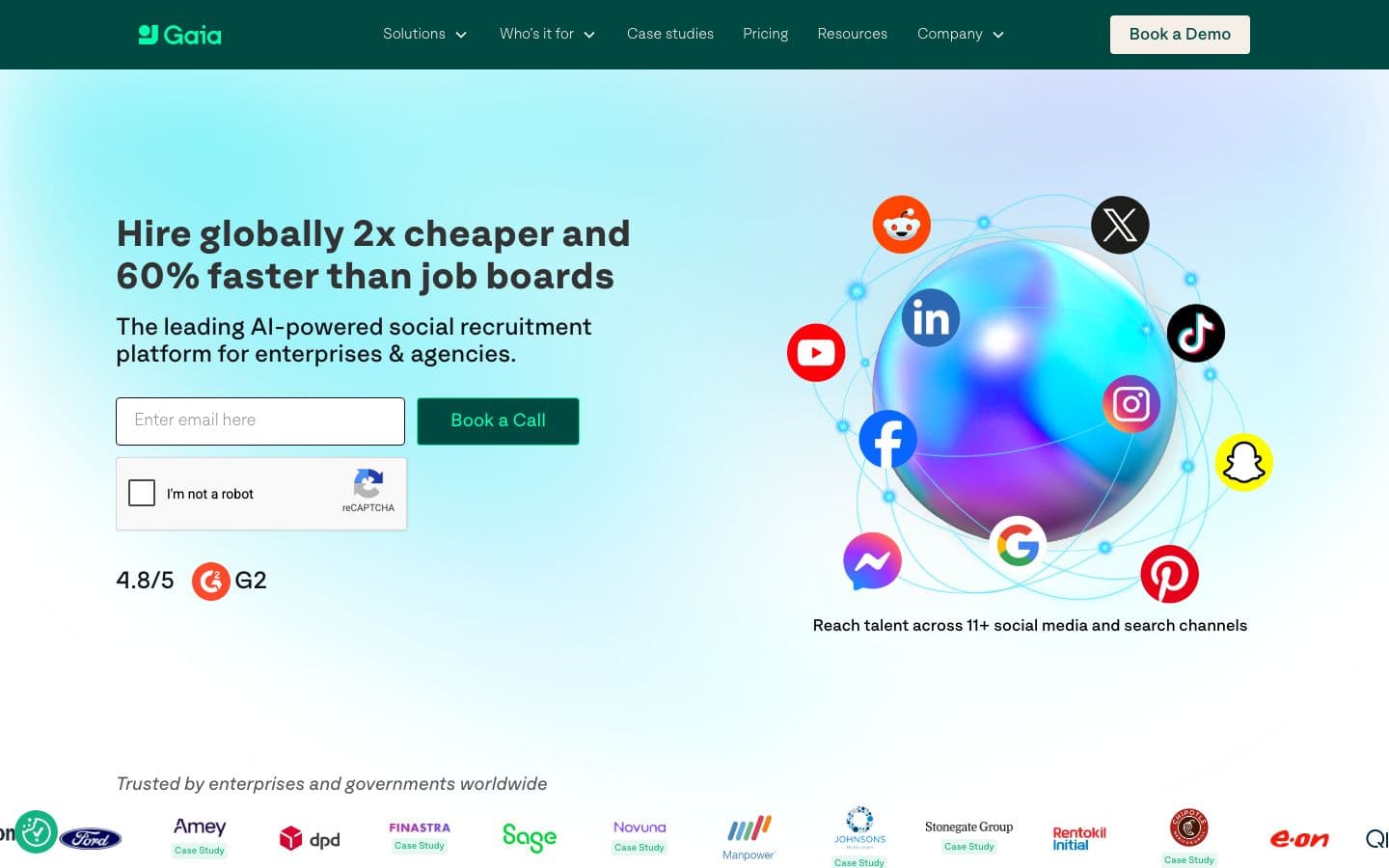
Gaia runs the hiring campaign for you. It syncs vacancies from your ATS, generates AI ad creatives "aligned to your employer brand", then buys, targets and optimises the media across 11+ social and search channels with AI bidding, real-time budget reallocation and cookie-free retargeting, landing candidates on AI-built branded application pages and through a chatbot that writes back into your ATS. You can buy it fully managed as GaiaComplete or run it yourself as GaiaSelf-Serve. RecruitmentAds does one narrower job and stops: it turns a single vacancy URL into a finished on-brand ad-set (a recruitment video in 9:16, 4:5, 1:1 and landscape plus matching statics, with AI voice-over and versions in any language) that you, your agency or your media partner run in your own accounts, with the visual source your choice per template: AI visuals built from the job description, real employee photos in on-brand layouts, or approved assets only with no AI people. So this is not a swap. It is a question about which layer you are buying, and RecruitmentAds is the easier of the two to evaluate before a conversation: our plan tiers, ad-set volumes and 90-day pilot terms are published, while Gaia's pricing page states that it has no pricing table at all.
Gaia facts checked against iamgaia.com and third-party sources on 5 August 2026 and carried into this page from the research dossier; no page was re-fetched during production. Review, headcount and search-volume figures are secondhand or third-party and labelled where they appear.
What each tool is
Gaia
Gaia is a London social recruitment marketing company, founded in 2017 as Socially Recruited by Ben Keighley and Gareth Thyer-Jones, which acquired the education-recruitment specialist soccialy in 2024 and rebranded. It is around 50 people and sells three products in two service models: GaiaAttract generates AI ad creatives and runs hyper-targeted campaigns across 11+ social and search channels with AI bidding, dynamic real-time spend reallocation and cookie-free retargeting; GaiaPages builds branded application and landing pages that auto-populate your ATS; GaiaChat is a multilingual chatbot with a video-apply route. You buy it managed as GaiaComplete or run it yourself as GaiaSelf-Serve, which it says over 500 hiring teams use. Its homepage claims 40+ no-code ATS integrations (Workday, Greenhouse, Lever, BambooHR, BreatheHR and Ashby are named), and its own comparison content claims 50+ with two-way sync. Its proof is heavily UK, frontline and public sector: it publishes case studies for Mitie (250+ hired at £240 cost per hire and £12 per application), Babcock (571 hired at £200 cost per hire, £80K saved), DHU Healthcare (£2.5m cost benefit, £820 cost per hire, 39-day reduction in time to start) and Amey (71 roles filled, 90% fill rate in three weeks), alongside the NHS, police forces, schools and colleges, with Chipotle, Amazon, Ford, Sky, Lidl, DPD and Finastra among its private-sector logos.
RecruitmentAds
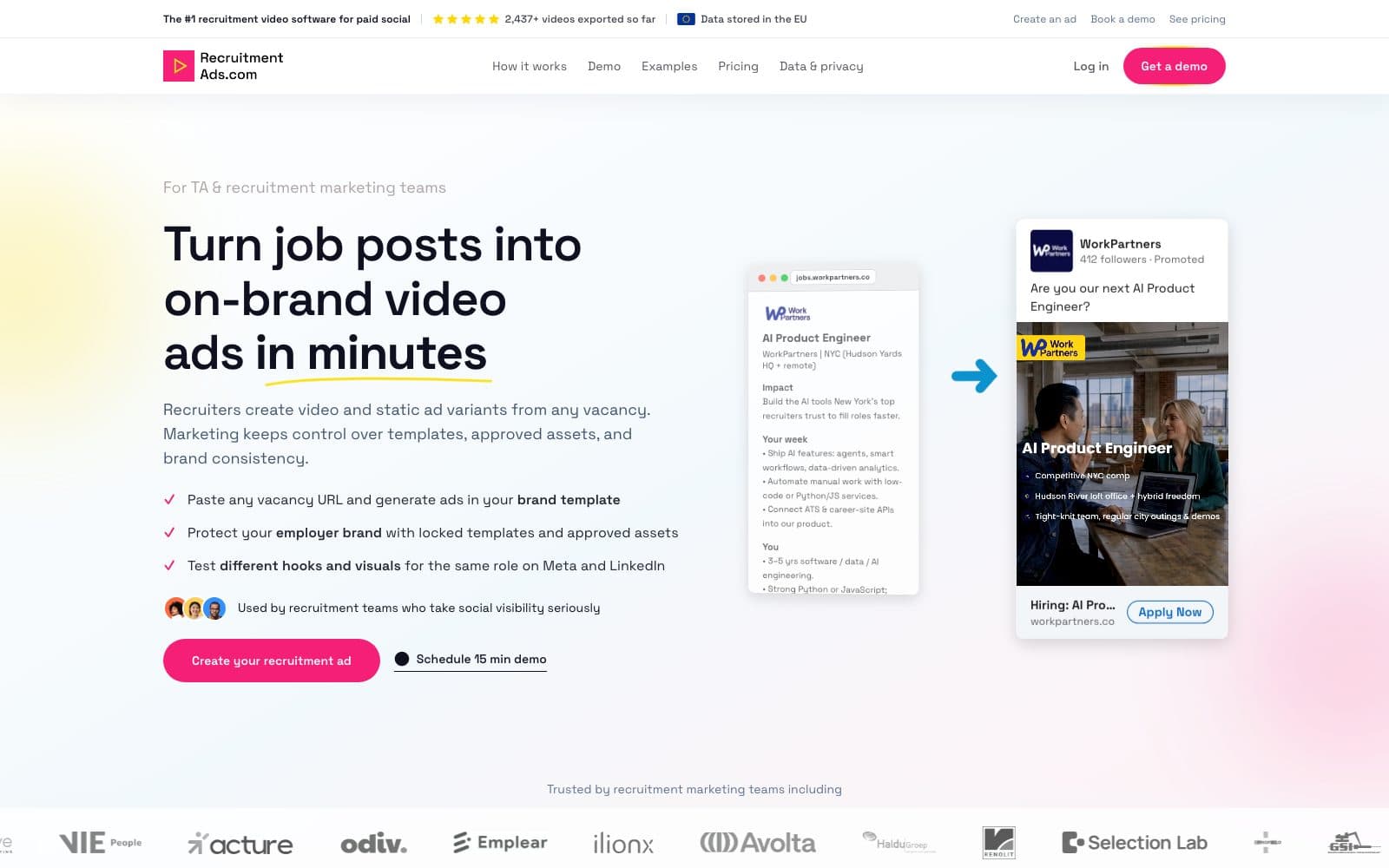
RecruitmentAds is an AI recruitment-creative tool. Paste a vacancy URL and it returns a finished on-brand ad-set for that role (a recruitment video in 9:16, 4:5, 1:1 and landscape plus matching static versions), built inside a locked brand template that carries your logo, fonts and colours, with AI voice-over written from the job text and versions in any language. Marketing decides per template which visual source recruiters may use: AI-generated scenes built from the job description, real employee photos placed in on-brand layouts, or approved assets only with no AI-generated people. You can generate several variants of the same vacancy to test different hooks. It does not buy media, does not host application pages, does not screen candidates and has no native ATS integration: the exports are files you upload to your own Meta and LinkedIn accounts, hand to your agency, or feed into whichever distribution platform you already pay for.
When Gaia wins, and when RecruitmentAds wins
Both tools start from a role and produce an ad, and that is where the overlap ends: Gaia's ad goes straight into a campaign it runs for you, ours comes back as files you run yourself. Only one of the two can be evaluated before a sales conversation: RecruitmentAds publishes plan tiers, ad-set volumes and 90-day pilot terms and will build a sample from your job link, while Gaia states on its own pricing page that it publishes no pricing table.
When Gaia wins
You want the media run for you, end to end, and you are measured on cost per hire
Gaia buys, targets, bids and retargets across 11+ social and search channels, either fully managed as GaiaComplete or self-managed as GaiaSelf-Serve, and its published proof is exactly that shape: 571 hires at Babcock at £200 cost per hire, 250+ at Mitie at £240 cost per hire and £12 per application, £2.5m cost benefit at DHU Healthcare. RecruitmentAds buys no media and publishes no cost-per-hire numbers, because our product stops before the spend that produces them. If the outcome you are buying is filled roles at a media price, Gaia is the right shape and we are the wrong one.
You need the funnel between the ad and the interview
GaiaPages builds AI-generated branded application and landing pages that auto-populate your ATS, and GaiaChat is a multilingual chatbot with a video-apply route that carries applications into the ATS. RecruitmentAds has no landing page, no application flow, no chatbot and no screening layer, and does not claim one. For high-volume frontline hiring, where drop-off between click and application is the whole problem, that funnel is the product, and it is a genuine reason not to switch.
Your vacancies must flow automatically from a long ATS integration list
Gaia claims 40+ no-code ATS integrations on its homepage and 50+ with two-way sync in its own comparison content, naming Workday, Greenhouse, Lever, BambooHR, BreatheHR and Ashby, with job sync and candidate-change tracking through GaiaAttract. RecruitmentAds has no native ATS integration at all: you paste a link per role. If a thousand requisitions have to advertise themselves without a human touching them, that is a hard requirement we do not meet.
When RecruitmentAds wins
You need the creative to be video, and to be a file you own
RecruitmentAds generates a recruitment video per vacancy with AI voice-over and exports 9:16, 4:5, 1:1 and landscape plus matching statics from one job link, and hands them over as downloadable files you can run in your own accounts, at your agency, or inside someone else's programme. Gaia's creative is generated to live inside Gaia campaigns (no export, format or file-ownership terms appear on its public pages), and no video creative output is claimed on its product pages as of 5 August 2026, which is a question to put to them rather than a conclusion to draw.
You want the visual source to be a decision marketing makes, not a default
RecruitmentAds asks which visuals each template may use: AI-generated scenes built from the job description, your real employees' photos in on-brand layouts, or approved assets only with no AI-generated people at all. It locks the template, fonts, colours and asset library around that choice, with custom on-brand templates on Custom and Scale and enterprise governance and user roles on Scale. Gaia's published creative governance is the phrase 'aligned to your employer brand', with AI-powered prompts and pre-built templates as the stated controls; no visual-source setting, approval step or asset-source rule is documented.
You want to price it and see it on your own role before anyone calls you
RecruitmentAds publishes Starter, Custom and Scale for employers and staffing firms plus an annual agency and RPO plan, with ad-set volumes, seat counts and 90-day pilot terms in EUR, GBP or USD by region, and will build the ad-set from one of your live vacancy URLs so you can judge the output before you buy. Gaia's pricing page states plainly that it has no pricing table, and its public numbers are savings claims rather than prices, a defensible position for a managed media programme, and a slower path to a comparable figure.
Who should pick what
Sole recruiter
A sole recruiter is not the buyer Gaia is shaped for: GaiaComplete is a managed media programme, and even GaiaSelf-Serve arrives with a quote and a media budget attached, with integrations Gaia describes as "dependent on tier". So the realistic question for one person is whether they need campaigns run or ads made; RecruitmentAds' published Starter plan and 90-day pilot is the cheaper way to get one real on-brand video and static set for one live role this week, without a media commitment.
TA team
For a TA team the honest split is who owns the media: if you want vacancies advertised, retargeted, landed on an application page and taken through its chatbot without anyone on your side opening a tool, Gaia is the stronger offer and RecruitmentAds cannot replace it; if your distribution is already handled (by an agency, an in-house buyer, or a programmatic platform you already pay for) and the bottleneck is on-brand creative per role, RecruitmentAds is the layer you are missing, and running both is a normal outcome of this comparison.
Employer-branding-led buyer
An employer-branding-led buyer should compare the two on who controls the visuals and who keeps the files: RecruitmentAds locks the template and makes the visual source an explicit per-template setting (AI visuals, real employee photos, or approved assets only), and hands you exports you own, while Gaia's published creative governance is the single phrase "aligned to your employer brand", with no visual-source control, no approval step and no export or file-ownership terms documented as of 5 August 2026, so those are the first three questions to put to them.
Ready to evaluate Gaia vs RecruitmentAds on your own vacancy? Try it in a 90-day pilot, or request a sample with your job link.
Gaia vs RecruitmentAds, row by row
Every cell is a full sentence naming the tool, so it still means something quoted on its own. Gaia rows describe what Gaia published as of 5 August 2026; RecruitmentAds rows describe shipped behaviour, including where nothing ships.
Facts verified 2026-08-05. “—” means not published by the vendor.
| Comparison | Gaia | RecruitmentAds |
|---|---|---|
| What it is | Gaia (iamgaia.com, formerly Socially Recruited, not the gaia.com streaming service) is a London social recruitment marketing company that generates AI ad creatives and runs hyper-targeted hiring campaigns across 11+ social and search channels, with branded application pages and a chatbot on top. | RecruitmentAds is an AI creative tool that turns one vacancy URL into a finished on-brand recruitment ad-set (video in every standard format plus matching statics) for you or your agency to run wherever you already advertise. |
| What it is for | Gaia is for buying the outcome: you hand over roles and budget, and Gaia's team or platform handles creative, targeting, bidding, retargeting, application pages and chatbot-mediated applications as one programme. | RecruitmentAds is for making the thing that runs in the ad: it produces the creative and stops, leaving distribution, targeting, budget and applicant handling entirely with you. |
| Where it sits | Gaia is an adjacent-distribution vendor: its creative engine exists to feed its own media buying, and no export, format or file-ownership terms are documented on its public pages as of 5 August 2026, so nothing published positions the creative as an asset you take elsewhere. | RecruitmentAds is a creative-only layer that sits upstream of any distribution route, including Gaia's: the exports are files, so whoever runs your media can run them. |
| How a vacancy gets in | Gaia ingests vacancies through ATS job sync (GaiaAttract advertises '1 Click Installations' with job sync and candidate-change tracking) alongside a role brief with targeting and budget parameters; voice-command campaign management, briefing the platform 'similar to Siri or Alexa', is attributed to Gaia in comparison content recited by answer surfaces rather than read on a Gaia page, so treat it as secondhand as of 5 August 2026. | RecruitmentAds starts from a single vacancy URL or pasted job text and pulls the title, requirements, perks, logo, fonts and brand colours into your locked template; there is no feed and no ATS connection, which is deliberate for per-role craft and wrong for a thousand-requisition queue. |
| Creative generation | Gaia generates ad creatives with AI from the synced role ('Generate ads with AI… Create custom ad creatives instantly, aligned to your employer brand') using AI-powered prompts and pre-built templates as the stated creative controls. | RecruitmentAds generates a scripted recruitment video plus matching statics per vacancy inside a locked brand template, with AI voice-over written from the job text and several variants per role for testing different hooks. |
| Video output | Gaia's video creative output is not established in either direction: no video generation is claimed on its products page, its self-serve page or its own nine-vendor comparison page as read on 5 August 2026, one homepage capture produced an unanchored summary mentioning video and static ads, and its blog recommends video ads as practice rather than as product. Treat this as unpublished, not proven absent, and ask for a demo on your own role. | RecruitmentAds generates a recruitment video per vacancy with AI voice-over and exports 9:16, 4:5, 1:1 and landscape cuts from the same job link. |
| Static ads | Gaia produces AI-generated static ad creatives as a documented part of GaiaAttract and GaiaSelf-Serve, positioned as instant creation aligned to your employer brand. | RecruitmentAds includes matching static versions of the same concept in every ad set, so a video-versus-image test on one role comes out of one ad set rather than two briefs. |
| Visual-source choice | Gaia specifies no visual-source choice anywhere we found: nothing on its published pages lets you choose between AI-generated imagery, your real employees' photos, and approved assets only, and 'AI-powered prompts and pre-built templates' is the extent of the stated creative control. | RecruitmentAds makes the visual source an explicit per-template setting (AI visuals built from the job description, real employee photos in on-brand layouts, or approved assets only with no AI-generated people), and marketing decides which modes recruiters may use. |
| Brand governance | Gaia's published governance claim is the phrase 'aligned to your employer brand'; no locked templates, approval workflow, asset library or role-based control is described on its public pages as of 5 August 2026. | RecruitmentAds locks the template, fonts, colours and approved asset library so a recruiter shipping a role at 4pm cannot drift the brand, ships custom on-brand templates on the Custom and Scale plans, and adds enterprise governance and user roles on Scale. |
| Who runs the media | Gaia runs the media itself (AI bidding, dynamic real-time spend reallocation and cookie-free retargeting across its channel set), either fully managed as GaiaComplete or self-managed by your team as GaiaSelf-Serve. | RecruitmentAds buys and manages no media at all: you upload the exports to your own Meta and LinkedIn accounts, or hand them to the agency or platform that already runs your campaigns. |
| Channels | Gaia names 11+ social and search channels (TikTok, Instagram, YouTube, LinkedIn, Facebook, Messenger, X, Snapchat and Google, with Reddit and Pinterest added in its own comparison content), and its historic press adds thousands of further sites and apps. | RecruitmentAds exports in the formats Meta and LinkedIn Campaign Manager expect, plus landscape for career sites and organic posts, and the same files work on any channel your media partner buys. |
| Application pages and screening | Gaia carries the funnel past the ad: GaiaPages builds AI-generated branded application and landing pages that auto-populate your ATS, and GaiaChat is a multilingual chatbot with a video-apply route. | RecruitmentAds has no landing page, application flow, chatbot or screening layer of any kind, and does not claim one; candidates follow whatever apply path your own campaign points them at. |
| ATS integration | Gaia claims 40+ no-code ATS integrations on its homepage and 50+ with two-way sync in its own comparison content (a discrepancy we have left as found), and names Workday, Greenhouse, Lever, BambooHR, BreatheHR and Ashby, with GaiaSelf-Serve noting that integrations are 'dependent on tier'. | RecruitmentAds has no native ATS integration today: vacancies enter by URL or pasted text, and any ATS step stays manual in your process. |
| File ownership and portability | Gaia documents no export, format or file-ownership terms on its public pages, which follows from the product shape: the creative is generated to run inside Gaia's own campaigns. | RecruitmentAds hands over downloadable files as the product, so the same ad-set can run in your ad account, your agency's, or a programmatic platform, including alongside a Gaia programme. |
| Languages | Gaia claims multilingual support for GaiaChat; no language list for its ad creative is published, and its site and content are English-language and UK-centric. | RecruitmentAds exports on-screen text and AI voice-over in any language from the same job post and the same locked template. |
| Pricing and how you evaluate it | Gaia publishes no prices and says so deliberately: its pricing page states 'We've not got a pricing table that will outline a cookie-cutter recruitment approach', quoting instead savings claims of up to 60% on recruitment marketing costs, 2x cheaper than job boards and over 63% cost reduction, with quotes segmented by agencies, public sector and private sector. | RecruitmentAds publishes its plans on recruitmentads.com/pricing (Starter, Custom and Scale for employers and staffing firms plus an annual agency and RPO plan) with monthly and annual ad-set volumes, seat counts and 90-day pilot terms in EUR, GBP or USD by region, so you can price the evaluation before you book a call. |
| Proof and references | Gaia's published proof is heavy, specific and media-shaped: Babcock 571 hired at £200 cost per hire with £80K saved, Mitie 250+ hired at £240 cost per hire and £12 per application, DHU Healthcare £2.5m cost benefit at £820 cost per hire, Amey 71 roles filled at a 90% fill rate in three weeks, plus its own figures of 4.3 million candidates starting applications through its ads in 2024 and 150% year-on-year growth. | RecruitmentAds publishes no cost-per-hire or applicant-volume statistics of its own on this page, because our product stops before the media that produces them; the number we can put in front of you is what one of your own vacancies looks like as a finished ad-set. |
| Best for | Gaia is best for high-volume frontline and public-sector employers, and the agencies serving them, that want social recruitment campaigns generated, bought and optimised end to end, with the application step carried by its own pages and chatbot, managed or self-serve. | RecruitmentAds is best for in-house TA and employer-brand teams, staffing firms, agencies and RPO teams that need a finished on-brand ad-set per vacancy while media buying, budget and targeting stay in their own hands. |
| Core market and scale | Gaia is London-based with around 50 people (its about page says 50+, LeadIQ reported roughly 51 across three continents in December 2025), and its measurable brand demand is UK-domestic, with 'gaia recruitment' at 390 monthly searches in the UK against 10 in the US as of 5 August 2026. | RecruitmentAds sells to EU, UK and US buyers with regional pricing in EUR, GBP and USD, and localises the same creative into any language rather than staffing regional delivery teams. |
What most Gaia comparisons miss
Almost every comparison of Gaia you can find was written by a company competing with Gaia. Gaia itself runs a comparison cluster under /resources: dedicated pages against Wonderkind, Adway, Findem, Aimwel, MrWork and Adzuna, a nine-vendor roundup, and budget-line pages against LinkedIn Jobs and against job boards and aggregators. Adway runs the mirror image, publishing its own Gaia comparison at adway.ai. This page is the third vendor-written comparison in that set, and we would rather say so than pretend otherwise. What all of them have in common, ours included, is a thumb on the scale, so the useful thing to notice is which questions none of them asks. Answer surfaces already recite both sides' self-published copy verbatim: Gaia's "1 billion hiring data points", its cookie-free retargeting, its voice-command campaign management "similar to Siri or Alexa". Those phrases travel because two companies wrote them, not because anyone checked them.
Switching from Gaia to RecruitmentAds
What changes
- The honest first line: for most Gaia customers this is not a switch, it is an unbundling. Gaia buys and optimises your media, hosts your application pages and takes applicants through its chatbot into your ATS. RecruitmentAds does none of that. If you leave Gaia for us and have no other distribution route, you have replaced a campaign programme with a folder of files.
- Media buying moves to you or your agency. Someone has to own the Meta, LinkedIn and TikTok campaigns, the budget, the targeting and the retargeting that Gaia was running across 11+ channels.
- The application layer moves too. GaiaPages' branded application pages and GaiaChat's chatbot have no RecruitmentAds equivalent, so candidates go back to your career site and your ATS apply flow.
- Vacancy intake becomes deliberate rather than automatic. Instead of an ATS sync pushing every requisition into an always-on programme, a person pastes a job link when a role deserves creative.
- What you gain is the creative layer as a product you control: video plus matching statics per vacancy, a locked brand template, and the visual source as an explicit decision (AI visuals, real employee photos, or approved assets only).
What maps to what
- Your ATS job sync → a vacancy URL or pasted job text per role, into your locked RecruitmentAds template.
- Gaia's AI-generated ad creatives per campaign → a finished ad-set per vacancy: video in 9:16, 4:5, 1:1 and landscape plus matching statics, with several variants for hook testing.
- Gaia's 'aligned to your employer brand' → a locked template carrying your logo, fonts, colours and approved asset library, with the visual modes marketing allows set per template.
- Gaia's channel spread → export formats that fit Meta and LinkedIn Campaign Manager, plus landscape for career sites and organic posts, usable by whichever buyer runs your media.
- GaiaChat's multilingual support → on-screen text and AI voice-over in any language from the same job post and the same template.
What you keep
- Your ATS, untouched. RecruitmentAds does not connect to it, so there is nothing to migrate, disconnect or re-permission.
- Your ad accounts, pixels, audiences and historical campaign data, because the ads run in your accounts rather than a vendor's.
- Your media budget as a separate, visible line, priced apart from software rather than bundled into a programme.
- Your career site, your apply flow and your existing employee-photo consent process. RecruitmentAds works inside that process rather than replacing it.
- Gaia itself, if the media programme is working. The two products address different layers, and feeding your own on-brand video and static sets into a distribution partner is a normal way to run this.
What review sites report about Gaia
Secondhand and third-party figures, captured via search on 5 August 2026 rather than fetched from the review sites directly. Treat them as reported, not verified. RecruitmentAds does not quote its own review scores on this page.
G2 · reported 2026-08-05
4.6 out of 5 from 47 reviews, listed under the pre-rebrand product slug 'socially-recruited-gaia'
Capterra · reported 2026-08-05
No Gaia listing surfaced in search; presence unconfirmed
Evaluate RecruitmentAds on your own vacancy
Take a live role (ideally one Gaia is already advertising) and see what comes back. Bring the job link to a 15-minute demo and we build the ad-set on that vacancy: a recruitment video in 9:16, 4:5, 1:1 and landscape, matching statics, your fonts and colours in a locked template, AI voice-over, and your choice of AI visuals, real employee photos or approved assets only. Then run it wherever your media already goes, Gaia included. Plan tiers, ad-set volumes and the 90-day pilot terms are published, so you can decide whether this is worth an hour of your time before you speak to anyone.
Questions buyers actually ask
Which Gaia is this, and is it the company on the stock market?
No. This page is about Gaia at iamgaia.com, the London recruitment marketing company legally named Socially Recruited Limited, founded in 2017 by Ben Keighley and Gareth Thyer-Jones and rebranded from Socially Recruited after it acquired soccialy in 2024. The NASDAQ-listed company trading as GAIA is gaia.com, a streaming service with no connection to recruitment; gaia.co and Gaia AI are two further unrelated businesses. This matters practically: the bare brand token resolves to the streaming company in search, so reviews, pricing pages and share-price data you find under 'gaia' are usually about a different business. Search 'gaia recruitment' or 'socially recruited' to reach the right one.
What does Gaia actually do: creative, media, or both?
Both, as one programme. GaiaAttract generates AI ad creatives from a synced vacancy and then buys, targets and optimises the media across 11+ social and search channels with AI bidding, real-time spend reallocation and cookie-free retargeting. GaiaPages builds branded application pages that auto-populate your ATS, and GaiaChat is a multilingual chatbot with a video-apply route that carries applications into the ATS. You buy it managed as GaiaComplete or self-managed as GaiaSelf-Serve. That is a different purchase from a creative tool: with Gaia the campaign runs through the vendor, with RecruitmentAds a finished ad-set runs in your own accounts, and the creative is a file you keep.
Does Gaia make recruitment videos?
We cannot tell you, and we will not guess. As read on 5 August 2026, no video creative output is claimed on Gaia's products page, its self-serve page or its own nine-vendor comparison page, and its blog recommends video ads as a practice rather than as something the product makes; one homepage capture produced a summary mentioning video and static ads that we could not tie to a verbatim claim. So treat video as unpublished rather than proven absent, and ask Gaia to demonstrate it on one of your own roles. RecruitmentAds generates a recruitment video per vacancy with AI voice-over and exports 9:16, 4:5, 1:1 and landscape cuts plus matching statics from one job link, and will show you that on your vacancy before you buy.
How much does Gaia cost, and how do I compare it with RecruitmentAds?
Gaia publishes no prices and says so on purpose: its pricing page states that it has no pricing table that would outline a cookie-cutter recruitment approach, and quotes are custom per organisation, segmented by agencies, public sector and private sector. What it publishes instead are savings claims: up to 60% on recruitment marketing costs, hiring 2x cheaper and 60% faster than job boards, over 63% cost reduction. Those are programme-level outcomes, not prices, so before you can compare anything you need Gaia's software cost and your media spend as two separate numbers. RecruitmentAds publishes plan tiers, ad-set volumes, seat counts and 90-day pilot terms on its pricing page in EUR, GBP or USD by region, and will build a sample from your job link, so the evaluation can be priced and seen before a sales conversation.
We already run Gaia. Should we replace it, or can the two run together?
Together, almost always. The honest answer is that most Gaia customers should not replace it. If Gaia is buying and optimising your media across 11+ channels, hosting your application pages and taking applicants through its chatbot, RecruitmentAds replaces none of that: we buy no media, host no pages and screen nobody. What we add is the creative layer as a product you control, in a locked template with the visual source set to AI visuals, real employee photos or approved assets only. Because RecruitmentAds exports downloadable video and static files rather than publishing anything itself, the same ad-set can go into a Gaia programme, an agency's ad account, or your own campaigns, and there is nothing to disconnect: we have no ATS integration and no media role. One question to put to Gaia: can their campaigns run creative you supply, and in which formats? The answer tells you whether layering is clean or needs a conversation.
Who should genuinely stay with Gaia?
Anyone whose buying question is cost per hire on volume. Gaia's published case studies are frontline and public sector, with hard media numbers: 571 hires at Babcock at £200 per hire, 250+ at Mitie at £240 per hire and £12 per application, £2.5m cost benefit at DHU Healthcare, 71 roles at Amey at a 90% fill rate in three weeks. If you need someone to run the whole programme, if you need branded application pages and a chatbot between the ad and the interview, or if two-way ATS sync across a long integration list is a procurement requirement, Gaia has all of that and RecruitmentAds has none of it. Come to us when the media is handled and the missing piece is on-brand creative per role.
Related guide: programmatic job advertising: how it works, and where it stops.
How we compared these two tools
Every Gaia capability, price, customer number and company fact on this page comes from the research pass completed on 5 August 2026, which read iamgaia.com (its homepage, products, self-serve, pricing, about and case-study pages, and its own comparison cluster) plus third-party sources for reviews and headcount. Nothing was re-fetched while this page was written, so treat 5 August 2026 as the currency date on every Gaia claim here. Gaia's figures are quoted as Gaia's published claims, not as results we have tested or audited: we do not have a Gaia account and we have not seen a demo. Review scores and headcount are secondhand and labelled where they appear. Where Gaia publishes nothing on a capability, this page says so and dates it, rather than treating silence as proof of absence; that rule is doing real work in the video row. RecruitmentAds facts come from our own published product and pricing pages.
- Ask Gaia to show video creative on your own role, and ask whether it is generated or supplied. No video creative output appears on Gaia's product pages, its self-serve page or its own nine-vendor comparison page in our 5 August 2026 read, and one homepage capture produced a summary mentioning video and static ads that we could not anchor to a verbatim claim. That is unresolved evidence, not a gap in their product; get it demonstrated before you draw a conclusion either way.
- Ask where the visuals come from and what you can forbid. AI-generated people, stock imagery, and your own employees' photography are three different legal conversations, and only one of them survives a strict portrait-rights or AI-disclosure policy. Gaia's published creative controls are 'AI-powered prompts and pre-built templates'; ask what the template actually locks.
- Ask whether you can export the creative and run it elsewhere, and what happens to it if the programme ends. Gaia's creative is generated to run inside Gaia's own campaigns, and no export, format or file-ownership terms are documented on its public pages.
- Ask for platform cost and media spend as two separate numbers. Gaia states plainly that it does not publish a pricing table, and its public figures are savings claims (up to 60% on recruitment marketing costs, 2x cheaper than job boards, over 63% cost reduction) rather than prices. A savings percentage cannot be compared with a per-output price until the media line is separated from the software line.
- Pin down the ATS list and the tier it sits on. Gaia's homepage claims 40+ integrations and its own comparison content claims 50+ with two-way sync; six are named. GaiaSelf-Serve states that integrations are 'dependent on tier'. Ask which tier carries yours.
- Read the case-study numbers as cost-per-hire, not as creative performance. Gaia's published proof (Babcock at £200 per hire, Mitie at £240, DHU at £820) measures a managed media programme end to end. Those are strong numbers for what they measure and they say nothing about the ad creative in isolation, which is the layer you would be comparing with us.
Keep comparing