
Recruitics alternative (2026): Recruitics vs RecruitmentAds
This page is about Recruitics at recruitics.com, the US recruitment-marketing company founded in 2012 in Norwalk, Connecticut. It also covers Jamyr (jamyr.com), the employee-video product Recruitics acquired in May 2023 and still runs under its own brand, because that is where video lives in their portfolio.
These two tools are not substitutes, and the useful comparison starts by saying so. Recruitics is where a recruitment media budget goes: a programmatic job-advertising and analytics platform (Predict, Attract, Convert and ApplyAnywhere) wrapped in a full agency that plans and buys media, builds career sites, consults on strategy and produces creative, all in one contract. RecruitmentAds is what goes inside the ad: paste one live vacancy URL and it returns a finished on-brand ad-set for that role, a recruitment video in every standard format plus matching statics, for your team to run in your own Meta and LinkedIn accounts. Recruitics does have video, in two shapes (films its agency creative team produces from a brief, and Jamyr, where your employees record themselves on their own devices and Jamyr's in-house team edits and hosts the result), but nothing in its published product turns a vacancy into an ad-set, and nothing offers a per-template choice between AI visuals, real employee photos and approved assets only. The last practical difference is how far you can get on your own: Recruitics publishes no prices for either the platform or the agency, while RecruitmentAds publishes its plans, ad-set allowances and 90-day pilot terms and will build a sample from a job link you bring.
Recruitics facts checked against recruitics.com and jamyr.com on 5 August 2026. Company, review and ownership figures are secondhand and labelled where they appear.
What each tool is
Recruitics
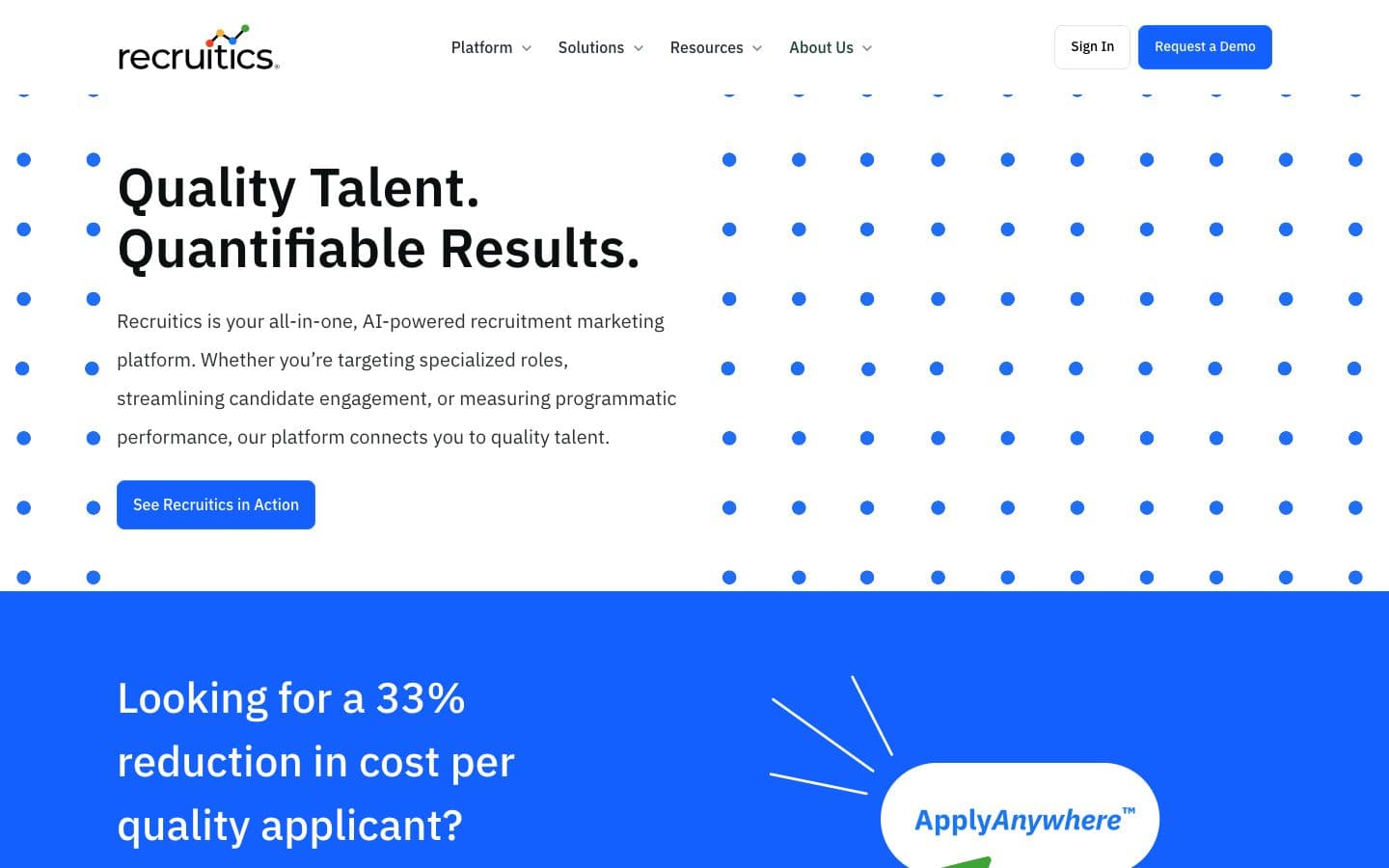
Recruitics is a US recruitment-marketing company founded in 2012 in Norwalk, Connecticut, and it sells two things at once. The first is software: a talent-attraction platform its own page calls "the complete talent attraction and conversion SaaS platform for modern talent acquisition teams", organised as Predict, Attract and Convert with an ApplyAnywhere application product alongside it, carrying SOC 2 Type 2 and naming nine ATS and platform integrations: Bullhorn, iCIMS, Fountain, Greenhouse, Paradox, Phenom, Haley Marketing, Hireology and NeoGov. The second is an agency: media planning and buying, employer-brand campaigns, career sites, strategic consulting and creative including, in its own words, "job branding or employer branding videos". It claims to have launched the world's first programmatic job optimisation platform in July 2012, has never raised outside venture funding and is majority-owned by Clark Group Holdings, the family holding company of co-founder Ken Clark; it has bought three companies: the agency KRT Marketing in 2019, the employee-video product Jamyr in May 2023, and the agency and consultancy Change State on a date it has not published. Its homepage names DoorDash, Chipotle, Walmart, Wayfair, Labcorp, Cross Country, Baylor Scott & White Health and HelloFresh, and its G2 seller description claims more than 400 enterprise organisations across 100+ countries (secondhand, 5 August 2026).
RecruitmentAds
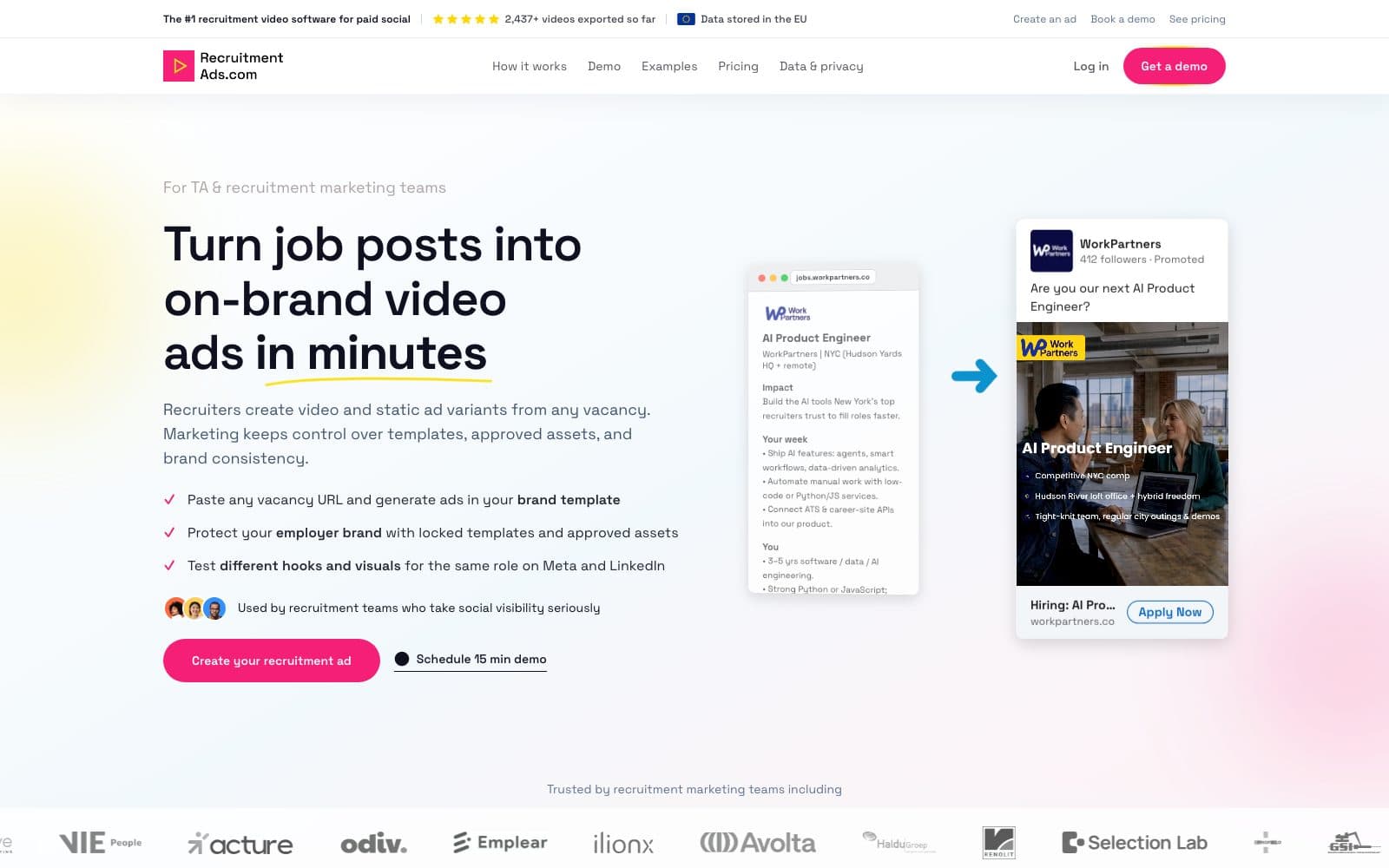
RecruitmentAds makes recruitment ad creative and stops there. Paste a live vacancy URL or the job text and it pulls the title, requirements, perks, logo, fonts and brand colours into a locked template, then returns a finished on-brand ad-set for that role: a recruitment video in 9:16, 4:5 and 1:1 with matching static ads, AI voice-over written from the job text, and versions in any language chosen at export. Marketing decides per template which visual source recruiters may use: AI-generated scenes built from the job description, real approved employee photos placed in on-brand layouts, or approved assets only with no AI-generated people. One ad set is one approved ad for one vacancy or message, exported in the video and static formats its template supports. It buys no media and manages no campaigns, has no native ATS integration and no public API, builds no career sites and touches no candidate data: you or your agency upload the exports into your own Meta and LinkedIn accounts. Plan tiers, ad-set allowances and 90-day pilot terms are published on its pricing page in EUR, GBP or USD by region.
When Recruitics wins, and when RecruitmentAds wins
The two tools answer different questions, so evaluate them on different things: judge Recruitics on cost per hire and on what its programmatic engine and agency deliver against your media budget, and judge RecruitmentAds on what comes back from one of your own vacancy URLs. On evaluation friction alone they are not close: RecruitmentAds' plans, ad-set allowances and 90-day pilot terms are published and the sample is built from your job link, while Recruitics is quote-only across both its platform and its agency as of 5 August 2026.
When Recruitics wins
You need the media bought, optimised and attributed, rather than creative files
Recruitics' core product is programmatic job advertising: it distributes and optimises job-ad spend across job boards and aggregators and reports on what it produced, and its homepage claims 40% lower cost per qualified candidate and a 35% decrease in cost-per-application (Recruitics-reported, read 5 August 2026). RecruitmentAds buys no media, bids on nothing and measures nothing: it hands you finished ad files and your own ad accounts do the rest. If the problem you are solving is where the budget goes and what it returned, we are not a candidate and should not be on your shortlist.
You want one procurement decision to cover strategy, media, career sites and creative
Recruitics sells software and an agency together: media planning and buying, employer-brand campaigns, career sites, consulting, candidate surveys through its Change State acquisition, and creative including employer-branding video, described on its agency page as "award-winning strategy, consulting, and creative — powered by exclusive technology and data". That is a lot of separate vendor relationships collapsed into one contract. RecruitmentAds is a single line item that produces ad creative, and cannot consolidate any of the rest.
Your video need is employee storytelling, captured from people rather than from a job post
Jamyr, which Recruitics acquired in May 2023 and still runs at jamyr.com, exists for exactly this: employees and candidates record themselves on their own devices, Jamyr's in-house team edits, transcribes and hosts the result, and the videos land as career-site widgets, ATS embeds, landing pages and MP4s for LinkedIn, Facebook and TikTok. If what you want is your actual people on camera telling their own stories at scale, that is a capture-and-edit workflow and it is not what RecruitmentAds does. We place approved employee photography into on-brand layouts; we do not collect footage from your workforce.
Procurement needs scale, tenure and a reference base
Recruitics has been trading since 2012, sits in LinkedIn's 201-500 employee band, carries SOC 2 Type 2 on its platform page, names Fortune-1000 logos including Walmart, DoorDash, Chipotle and Wayfair, and its G2 seller description claims more than 400 enterprise organisations (secondhand, 5 August 2026). RecruitmentAds publishes neither a headcount nor an analyst placement. If a long reference list is a gating requirement in your process, that gate is a real one and we do not clear it.
When RecruitmentAds wins
You want the vacancy itself to produce the ad-set, with no brief and no retainer
RecruitmentAds takes one live vacancy URL and returns the finished set for that role: video in 9:16, 4:5 and 1:1 plus matching statics, in your locked template, with AI voice-over written from the job text. Recruitics has no published path from a vacancy to a finished ad-set: its creative is an agency engagement that starts with a brief and runs on services economics, or it is Jamyr, which cannot start until an employee has recorded something. Both are real ways to get video made; neither is self-serve, and neither is keyed to the individual open role.
You want the visual source to be a decision your marketing team locks per template
RecruitmentAds makes the visual source an explicit setting: AI-generated scenes built from the job description, real approved employee photos placed in on-brand layouts, or approved assets only with no AI-generated people at all, and marketing chooses which modes each template allows. Recruitics publishes no equivalent concept anywhere: creative fidelity comes from whichever agency team is assigned or from whatever an employee recorded, and its creative and employer-branding services page lists no deliverables, formats, timelines or examples (read 5 August 2026). If your legal or brand team needs to forbid a mode rather than request one, that is a control you would be asking Recruitics to invent.
The layer you need is paid-social creative, which their platform does not touch
Recruitics' programmatic engine optimises job-board and aggregator spend; the craft of a Meta or LinkedIn ad-set (several hooks, every standard format, statics that match the video so you can test image against video on the same role) sits in its agency, not in its software. RecruitmentAds produces exactly that layer and hands the files over, so they run in your own ad account with your own pixel and audiences, alongside whatever programmatic distribution you already buy.
You want to price it and see it on your own role before speaking to anyone
RecruitmentAds publishes its plan tiers, ad-set allowances and 90-day pilot terms, and will build a sample ad-set from a live vacancy URL you bring. Recruitics publishes no pricing at all: not for the platform, not for the agency, and no third-party price band exists that we could find on 5 August 2026, so every evaluation starts with a conversation about your media budget.
Who should pick what
Sole recruiter
A sole recruiter is not a Recruitics buyer, and the page should say that plainly: Recruitics sells programmatic media, analytics and agency services to enterprise talent teams with a media budget to manage, and its named logos are companies like Walmart, DoorDash and Chipotle. RecruitmentAds fits a single recruiter who already has an ad account and whose actual bottleneck is producing on-brand creative for each vacancy: paste the job URL, take the exports, no brief and no design queue in between.
TA team
For an enterprise TA team the honest answer is usually both, not either. Recruitics runs the media and the measurement; RecruitmentAds produces the per-vacancy Meta and LinkedIn creative that programmatic job-board distribution does not cover. The question to settle internally is not which vendor wins but whether you want creative to arrive on an agency timeline, and if the answer is that recruiters need it the same afternoon, that is the gap this comparison is about.
Employer-branding-led buyer
An employer-branding-led buyer should compare these two on who controls the visuals and where they come from. Recruitics offers an award-winning agency and, through Jamyr, real employees filming themselves, strong for campaign-level brand work and for genuine employee storytelling, but with no published template governance and no visual-source setting. RecruitmentAds locks the template and makes the visual source an explicit per-template choice between AI visuals, real approved employee photos and approved-assets-only, which is the control that matters when a strict AI or portrait-rights policy has to hold across every recruiter's exports.
Ready to evaluate Recruitics vs RecruitmentAds on your own vacancy? Try it in a 90-day pilot, or request a sample with your job link.
Recruitics vs RecruitmentAds, row by row
Every cell is a full sentence naming the tool it describes, so no row can be misread when it is quoted on its own. Recruitics rows were read on its own published pages on 5 August 2026, except where a cell labels a figure secondhand; RecruitmentAds rows describe shipped behaviour, including the rows where nothing ships.
Facts verified 2026-08-05. “—” means not published by the vendor.
| Comparison | Recruitics | RecruitmentAds |
|---|---|---|
| What it is | Recruitics (recruitics.com) is a US recruitment-marketing company that sells a programmatic job-advertising and analytics platform (Predict, Attract, Convert and ApplyAnywhere) together with a full agency covering media planning and buying, career sites, consulting and creative. | RecruitmentAds is a recruitment ad production tool that turns one live vacancy into an on-brand video and static ad-set for Meta and LinkedIn, and does nothing else. |
| What it is for | Recruitics is for deciding where a recruitment media budget goes, spending it programmatically across job boards and aggregators, and reporting on what it returned, with an agency available to run the surrounding programme. | RecruitmentAds is for producing the creative that goes inside recruitment ads, one vacancy at a time, so recruiters can ship on-brand video and statics without a design queue. |
| How a vacancy gets in | Recruitics ingests job feeds and ATS data into its programmatic platform so that roles can be distributed and bid on; there is no published vacancy-URL-to-creative workflow anywhere in its product. | RecruitmentAds starts from a vacancy URL or pasted job text and extracts the title, requirements, perks, logo, fonts and brand colours into your locked template. |
| Where the creative comes from | Recruitics' creative comes from people: its agency creative team produces "job branding or employer branding videos" from a brief, or Jamyr collects self-recorded footage from your employees and candidates and its in-house team edits it, so nothing exists until someone has been briefed or has filmed something. | RecruitmentAds' creative comes from the vacancy: the job post is the input, the finished ad-set is the output, and the recruiter who needs it makes it themselves inside the template marketing locked. |
| Video output | Recruitics offers video in two non-generative modes: agency-produced employer-branding and job-branding films from its creative team, and Jamyr, where employees self-record on their own devices and Jamyr's in-house team edits, transcribes and hosts the result as career-site widgets, ATS embeds, landing pages and MP4s for LinkedIn, Facebook and TikTok. | RecruitmentAds generates a recruitment video per vacancy with AI voice-over written from the job text, exporting 9:16, 4:5 and 1:1 from the same job link, with several variants per role so different hooks can be tested. |
| Static ads | Recruitics ships no self-serve static ad generation: static creative is an agency deliverable, produced by its creative team as part of a services engagement. | RecruitmentAds includes matching static ads in the same ad set as the video, so image and video can be tested against each other on the same role without a second request. |
| Paid-social ad-sets | Recruitics does not output finished, portable paid-social ad-sets from its platform: its programmatic engine works job-board and aggregator inventory, and Meta or LinkedIn creative sits in the agency rather than in the software. | RecruitmentAds returns one vacancy as one finished set (every standard video format plus matching statics) sized for Meta and LinkedIn placement and downloaded as files you own. |
| Visual-source choice | Recruitics publishes no visual-source concept: the visuals are whatever the assigned agency team produces or whatever an employee recorded, with no per-campaign or per-template choice between AI-generated visuals, real employee photography and approved assets only. | RecruitmentAds makes the visual source an explicit per-template setting (AI-generated scenes from the job description, real approved employee photos in on-brand layouts, or approved assets only with no AI-generated people), and marketing decides which modes each template allows. |
| Brand governance | Recruitics offers brand consistency as an agency service (its agency page says "every decision, from media buys to creative assets, is backed by data") rather than as a productised, governed template system; no locked template, approved-asset library or approval step appears on its published pages. | RecruitmentAds locks the template, fonts, colours and approved asset library so recruiters export inside marketing's rules, marketing sets the permitted visual modes per template, and its Scale plan adds enterprise governance and user roles; it does not claim approval workflows or full role-based access control. |
| Media buying and distribution | Recruitics buys and optimises media programmatically across job boards and aggregators, and says it launched the world's first-to-market programmatic job optimisation platform in July 2012. This is its core competence and the reason most buyers are on its site. | RecruitmentAds buys no media and publishes nothing on your behalf: you upload the exports into your own Meta and LinkedIn accounts, and the budget relationship stays entirely yours. |
| Analytics and reporting | Recruitics sells analytics as a product: its Predict module offers AI dashboards and hiring forecasts, and its homepage reports 40% lower cost per qualified candidate and a 35% decrease in cost-per-application as its own results (Recruitics-reported, 5 August 2026). | RecruitmentAds reports on nothing: it produces creative files and has no measurement, attribution or campaign analytics of any kind, so performance data comes from whatever ad platform you run the exports in. |
| Candidate flow | Recruitics carries candidates further down the funnel with ApplyAnywhere application workflows, career sites, and Voice candidate surveys added through its Change State acquisition. | RecruitmentAds touches no candidate at any point: the ads point at your own vacancy pages, and application, screening and candidate records stay in the tools you already run. |
| ATS integration | Recruitics names nine ATS and platform integrations on its platform page (Bullhorn, iCIMS, Fountain, Greenhouse, Paradox, Phenom, Haley Marketing, Hireology and NeoGov), and that published list may be partial. | Not shipped: RecruitmentAds has no native ATS or Workday integration and no public API. Vacancies enter by URL or pasted text, so any ATS step is manual on your side. |
| Languages | Not published: Recruitics lists no supported languages for its platform or its creative; the "across 100+ countries" line comes from its G2 seller description, is secondhand as of 5 August 2026, and describes reach rather than localisation. | RecruitmentAds supports all languages for on-screen text and AI voice-over, chosen at export, so one job post can become versions for several language markets from the same template. |
| Pricing | Not published: Recruitics shows no prices for either the platform or the agency, its platform page describes a transparent pricing model with no hidden fees without giving a single figure, and no third-party price band could be found on 5 August 2026. A quote covers some mix of platform subscription, agency fees and media spend that is not broken out publicly. | Published: RecruitmentAds lists its employer plan tiers (Starter, Custom and Scale) plus agency and RPO plans, with ad-set allowances and 90-day pilot terms, in EUR, GBP or USD by region. |
| How you evaluate it | Recruitics is evaluated through a conversation: with no published pricing on either side of the business and no self-serve product, scoping starts with a call about your roles, your media budget and which parts of the platform and agency you would buy. | RecruitmentAds can be evaluated before a conversation: read the published plans, send one live vacancy URL and get the ad-set built from it, then run a fixed 90-day pilot on real roles. |
| Company scale | Recruitics has traded since 2012, sits in LinkedIn's 201-500 employee band (a secondhand scrape puts it at 203), has taken no outside venture funding, is majority-owned by Clark Group Holdings, carries SOC 2 Type 2, and has acquired three companies: KRT Marketing in 2019, Jamyr in May 2023 and Change State on an unpublished date. | RecruitmentAds publishes neither a headcount nor an analyst placement, so if vendor scale or a long enterprise reference base is a procurement gate, it is a gate Recruitics clears and RecruitmentAds does not. |
| Best for | Recruitics is best for Fortune-1000 talent teams that want recruitment marketing managed end to end: programmatic media, predictive analytics, career sites and agency creative bought in one decision. | RecruitmentAds is best for in-house TA teams, staffing firms and agency or RPO partners that need per-vacancy ad creative for Meta and LinkedIn without a design queue, inside brand rules marketing set once. |
What most Recruitics comparisons miss
The comparison surfaces cannot agree on what Recruitics is, and that is not a small detail: it changes who you end up benchmarking it against. G2 files Recruitics as programmatic software and leads its alternatives list with Radancy, then Appcast, Joveo, Veritone Hire and Talroo. Joveo's own recruitics-alternatives post reframes the same company as an agency and lists Shaker Recruitment Marketing, NAS Recruitment Innovation, Hope Leigh Marketing Group, Yoke and Hire Value as the peer set (both read 5 August 2026). Neither framing is wrong; Recruitics genuinely is both, sold in one contract. But if you shortlist from the software frame you will compare bidding engines, and if you shortlist from the agency frame you will compare retainers, and in neither case will anyone ask the question a hiring team actually has: when a role opens on Tuesday, who makes the ad, and how long does it take?
Adding RecruitmentAds alongside Recruitics
What changes
- Creative stops being a request and becomes a task. Instead of briefing an agency team or waiting for an employee to record something, a recruiter pastes the vacancy URL and the ad-set for that role comes back in one pass.
- The unit changes from a project to a vacancy. Agency creative is scoped per campaign or per engagement; a RecruitmentAds ad set is one approved ad for one vacancy, exported in every format its template supports.
- The visual source becomes an explicit decision (AI visuals from the job description, real approved employee photos, or approved assets only) set per template by marketing rather than left to whoever is producing.
- Nothing changes about your media. RecruitmentAds does not buy, bid, publish or report, so whatever Recruitics runs programmatically keeps running exactly as it does today.
What maps to what
- Recruitics' agency-produced employer-branding films map to your brand-level content, which stays where it is: RecruitmentAds does not replace campaign films, it covers the per-vacancy layer underneath them.
- Jamyr's employee-recorded videos map to RecruitmentAds' employee-photo mode only in spirit: we place approved photography into on-brand layouts, we do not capture new footage from your workforce, so if the storytelling itself is the point, keep Jamyr.
- Your brand guidelines, logo, fonts, colours and approved asset library map to the locked RecruitmentAds template that recruiters cannot drift.
- Your job feed maps to a job URL. Recruitics ingests feeds and ATS data for distribution; RecruitmentAds takes one vacancy URL or the pasted text per ad set.
What you keep
- Your programmatic media, your budget pacing and your cost-per-application reporting, none of which RecruitmentAds touches or can reproduce.
- Your career sites, your ApplyAnywhere or application flows, and your candidate data: no part of the candidate journey moves.
- Your ATS and its Recruitics integration. RecruitmentAds connects to no ATS, so there is nothing to disconnect and nothing to migrate.
- Your employee-photo consent process. RecruitmentAds uses approved photography inside the process you already run rather than replacing it.
- Recruitics itself. Adding a creative tool to a managed media relationship is the normal outcome of this comparison, not a failure of it.
What review sites report about Recruitics
All figures read on 5 August 2026 and all secondhand: direct G2 fetches were blocked, so these came from search snippets. Treat the rating with more than usual caution, because Recruitics' G2 presence is split across at least three separate listings. RecruitmentAds does not quote its own review scores on this page.
G2 (main listing) · reported 2026-08-05
Approximately 4.5 out of 5 from 49 reviews.
G2 (fragmented presence) · reported 2026-08-05
At least three separate G2 listings exist (the main one, a "Job Programmatic Advertising" listing carrying 8 reviews, and a legacy listing with a 2022-era alternatives page), so no single G2 number represents the whole company.
Capterra · reported 2026-08-05
No Recruitics listing was found when we searched on 5 August 2026. Absence is not conclusively proven.
Evaluate RecruitmentAds on your own vacancy
A category comparison can only take you so far when the two tools do different jobs. The faster test is to take one live role (ideally one Recruitics is already distributing for you) and see what comes back. Send the job link and we build the ad-set on that vacancy: video in 9:16, 4:5 and 1:1, matching statics, your fonts and colours in a locked template, AI voice-over in the language you hire in, and your choice of AI visuals, real approved employee photos or approved assets only. Our plan tiers, ad-set allowances and 90-day pilot terms are published, so you can price the creative layer against the roles you already have open before you change anything about your media.
Questions buyers actually ask
Is Recruitics a competitor to RecruitmentAds at all?
On one surface only. Recruitics' core business is programmatic job advertising, analytics and a full recruitment-marketing agency (media planning and buying, career sites, consulting, candidate surveys) and RecruitmentAds does none of that. Where they meet is creative: Recruitics' agency team produces what its own page calls "job branding or employer branding videos", and Recruitics has owned Jamyr, an employee-video product, since May 2023. So if the question in your organisation is who makes the recruitment videos and social ads, both names can appear. If the question is where the media budget goes, only one of them is an answer, and it is not us.
Does Recruitics turn a job posting into a video or an ad?
No. Nothing in Recruitics' published product converts a vacancy into finished creative. Its platform ingests job feeds and ATS data to distribute and bid on roles, and its two video routes both start with people rather than with the job post: an agency engagement that begins with a brief, or Jamyr, where employees and candidates record themselves on their own devices and Jamyr's in-house team edits, transcribes and hosts the result. RecruitmentAds takes the vacancy URL itself, reads the title, requirements, perks and brand assets from it, and returns the video formats plus matching statics for that role in one pass (all Recruitics facts read 5 August 2026).
What is Jamyr, and how is it different from RecruitmentAds?
Jamyr is an employee-video capture and editing service that Recruitics acquired in May 2023 and still runs at jamyr.com under its own brand. Employees or candidates record themselves on their own devices; Jamyr's in-house team edits, transcribes and hosts the videos, which are then embedded as career-site widgets, ATS embeds and landing pages, or downloaded as MP4s for LinkedIn, Facebook and TikTok. The bottleneck is participation: nothing exists until someone films something. RecruitmentAds never asks an employee to record anything: it builds the ad from the vacancy, and where you want real people in it, it places approved employee photography into on-brand layouts. If genuine spoken employee stories are the goal, Jamyr is the right shape and we are not a substitute for it.
How much does Recruitics cost, and how do I compare that with RecruitmentAds?
Recruitics is quote-only on both sides of its business: there is no pricing page on recruitics.com, its platform page describes a transparent pricing model with no hidden fees without publishing a figure, and we found no third-party price band on 5 August 2026. When you do get a quote, split it into platform subscription, agency fees and media spend before comparing it to anything, because a managed media budget and a creative tool's licence are not the same kind of number. RecruitmentAds publishes its employer plan tiers (Starter, Custom and Scale) plus agency and RPO plans, with ad-set allowances and 90-day pilot terms, so you can cost the creative layer on its own before any conversation.
We already use Recruitics. Would RecruitmentAds replace it?
Almost certainly not, and you should be suspicious of anyone who says otherwise. RecruitmentAds buys no media, runs no campaigns, builds no career sites, connects to no ATS and reports on nothing; replacing Recruitics with it would remove capabilities we simply do not have. What it replaces is the part where someone has to make the ads: one vacancy URL in, a finished on-brand video and static set out, in every standard format for Meta and LinkedIn, with the visual source locked to what your brand allows. Running both is the normal outcome: programmatic distribution stays where it is, and the per-vacancy creative stops being a request queue.
Do either of them integrate with our ATS?
Recruitics does, and names nine integrations on its platform page: Bullhorn, iCIMS, Fountain, Greenhouse, Paradox, Phenom, Haley Marketing, Hireology and NeoGov, a list that may be partial, so confirm yours is on it. RecruitmentAds does not: it has no native ATS or Workday integration and no public API, so vacancies enter by URL or pasted text and any ATS step stays manual on your side. If feed-level automation is a hard requirement for the creative layer too, that is a real gap on our side and worth surfacing early.
Related guide: programmatic job advertising: how it works, and where it stops.
How we compared these two tools
Every Recruitics capability and company fact on this page was read from recruitics.com and jamyr.com on 5 August 2026 and is presented as their published claim, not as a tested result: we have no Recruitics account, we have not seen an agency deliverable, and we have not used Jamyr. Company, ownership, headcount and review figures come from third parties (LinkedIn, Tracxn, Crunchbase, Clark Group Holdings, a prospeo.io scrape and G2 search snippets, because direct G2 fetches were blocked), and each is labelled secondhand where it appears. RecruitmentAds facts come from our own published product and pricing pages. Two structural cautions apply to this comparison specifically: these products sit in different categories, so most rows below describe a difference in purpose rather than a difference in quality; and no live SERP pull was run for this page, so nothing here claims what ranks or what an AI assistant will tell you.
- Ask Recruitics who makes the creative, and on what timeline. Its creative and employer-branding services page names no deliverables, formats, examples or turnaround times as of 5 August 2026, and "job branding or employer branding videos" is the most specific description of video on its agency page. Get the scope, the revision policy and the per-asset cost in writing before you compare anything.
- Ask whether Jamyr is included, integrated or sold separately. Jamyr has been Recruitics-owned since May 2023, still runs on its own domain and brand, and is not mentioned on the Recruitics creative-services page we read, so whether it comes with an agency engagement, with a platform subscription, or as its own line is a question the published pages do not answer.
- Ask for the full integration list and the tier it sits on. Nine ATS and platform integrations are named on the Recruitics platform page (Bullhorn, iCIMS, Fountain, Greenhouse, Paradox, Phenom, Haley Marketing, Hireology and NeoGov), and the list may be partial. RecruitmentAds has no native ATS integration at all, so on that row plan on pasting or linking the vacancy.
- Split the quote into its three parts before comparing anything to a software price. A Recruitics engagement can contain platform subscription, agency fees and media spend, and the split is unpublished. A creative tool's price and a managed media budget are not the same kind of number, and putting them side by side without that split will mislead your business case.
- Ask what happens to the creative if you leave. Agency-produced films, Jamyr-hosted videos and platform-managed campaigns each have different answers about ownership, hosting and portability, and none of them is published.
- Ask which languages the platform and the creative support. Recruitics publishes no language list; the "100+ countries" figure comes from a G2 seller description, is secondhand, and is a reach claim rather than a localisation capability.
Keep comparing